
Everything Matters
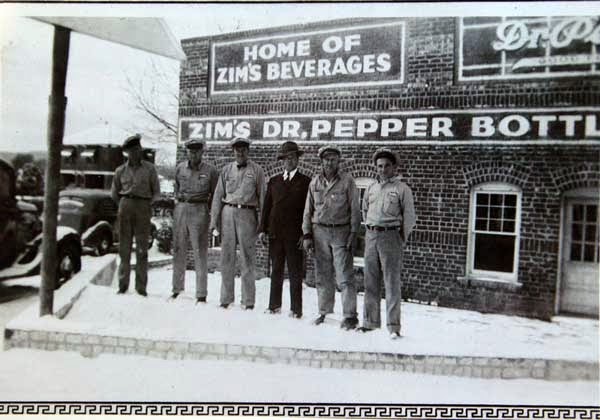
Zim's Bottling of Strawn
Showing posts with label Homesteads. Show all posts
Showing posts with label Homesteads. Show all posts
Saturday, January 24, 2015

Friday, January 23, 2015


Wednesday, January 21, 2015

Tuesday, March 4, 2014
Hohhertz Story
Hohhertz Oil Field Camp
Invites Past into Present
By Jeff Clark
Folks who
say Texas history
never dies haven’t driven enough dusty back roads. One passes old foundations, stacked
rock walls and “out of place” fence rows knowing that Lives unfolded out there.
Lives that
were never written down.
Teams of
archeologists, historians and forensic investigators could descend on the place,
I suppose. Years and millions of dollars later they could piece together a glossy
paper guess about the people who lived out there.
But without
those people, it’d still be a guess.

I was told
about the Hohhertz Camp, a Texas & Pacific Coal & Oil Company camp located
on Hohhertz Road ,
straddling the southeastern border between Palo Pinto and Stephens Counties
I didn’t
see a lot.
Like others
from my instant-messaging generation, I don’t have the time or that team of
specialists to help uncover all the lost places I hear about.
All those
clues calling from behind barbed wire fence rows.
Hohhertz Camp was started by the T
& P Coal & Oil Company sometime before 1917. Billy Gordon and his dad W.K.
of Thurber fame were said to be hunting around Hohhertz when the McClesky oil
well blew in that year, setting off the short-lived Ranger Oil Boom. They
returned to their car, finding a note on their steering wheel announcing the
news. That’s the earliest date I could verify. Seeping oil bedeviled several
coal mines to the south and southeast of the Hohhertz area in the late 1800s,
considered a nuisance by mine owners until Spindletop taught them better.

Oil camps were temporary settlements
where men drilled then pumped crude oil from the ground. The T & P believed
in owning everything – the land, the store, families’ homes, the school, the
office, the recreation hall, probably some tents. Think Thurber, but smaller,
more mobile.
There might’ve been 250 living in
the community near its beginning. When the wells were all drilled, this number tapered
down over the years.
Towards the 1930s, Hohhertz Camp changed
from drilling, to mostly pumping and maintenance. Make sure the oil continues
to flow, but we’ll be in Midland
or Odessa if
you need us.
I went through lots of folks who
held small pieces of the puzzle until I happened upon the Sinclair girls –
Ellen, Norma and Billye. They grew up there. And then Stanley Bowen. His childhood memories were
shaped a few yards down the 1 x 12 wooden side walk from the Sinclair house.
I pulled up a chair. Took out a
pen.

Hohhertz Camp was a community in
every sense of the word. The first row of five or six identical company-owned houses
lining Hohhertz Road
faced south, just across the Stephens
County
There were three rows of these houses,
maybe 18 total. There were four or five more homes scattered south into Palo Pinto
County
The Sinclair girls’ daddy William
Bryan Sinclair probably worked in Hohhertz longer than anyone, he maintaining a
pump station down the hill through the trees adjacent to the Hohhertz Ranch
until he retired in 1965. Sinclair could fix or build most anything. Rattlesnakes
slithered the countryside then and now. Below that hill sat a huge gas engine
(called “The Power” by residents) that ran 15 – 23 rod lines powering pumping oil
rigs in the fields.
The Sinclair house started with two
bedrooms, but Mr. Sinclair added a third. They had a bathroom and shower,
living room and kitchen. Their yard had cut grass and rock-lined flower beds.
If you’ve never been out to that part of the world, it’s rough rocky country.
The Sinclairs had a garden.

The camp houses boasted natural gas
and indoor plumbing, but no electricity until the REA years later. The Wirt Goodsons
owned a Maytag washing machine, though they had to heat the water in big
boiling pots and “prime” the clothes with the rub board first.
Toward the 1940s and 1950s there
were about 20 oil wells on the 800+ acre Stuart Place , the southern area of Hohhertz.
Lone Star Gas had a camp out there somewhere too.
Early Hohhertz Camp was said to have
a one room school on the south side of the road (below the water tower) that
closed around 1930. The Sinclair girls remember bus rides to Caddo through 6th
grade, then junior and senior high school students being bussed to
Breckenridge.
Families paid rent. Twelve
unmarried pumpers lived in a bunkhouse where meals were served. A party line
phone connected these homes across the cattle guard, a T & P company sign welded
overhead. The elevated water tank looks like a brother to the one at Thurber’s Big Lake

Kids used to play kick the can, ante
over, took walks, rode bikes and played ball in the street. The most vivid
activity I heard about was their Color Stores. These stores’ “inventory”
consisted of bottles the kids filled with colored water, which they would then
“sell” to each other. Stanley 's brother Junior Bowen always came up
with odd colors that nobody else could figure out how to make.
Paper dolls
were a big item, cutting the dolls out of Sears Catalog, using candy boxes as houses,
making all sorts of "furniture" then pulling the candy
boxes along with a string (moving their houses from place to place).
The boys had rough hewn clubhouses
out in the countryside where they’d smoke grapevine and carry on as boys will.
All these kids remembered the Color
Stores.

Families traveled to Ranger to buy
groceries and watch wrestling and boxing matches. Dave Mitchell had a hoedown at
one of the houses – guitars and banjos making everyone hoop and holler with
delight.
The Sinclairs remember a little
store with a little bit of everything. Troyce Boone’s dad Daniel ran the
Hohhertz Store in its earliest days. I don’t know if he owned it or just
managed it for the company. Bowen remembered Mrs. Herrington running this store
in the 30s and 40s. Then the Roaches. Mrs. Herrington lived in a company house,
though she was not a company employee like everyone else.
The T & P Office was on the
south side of the road. Don Bonney was the big boss, the superintendent, a nice
man, the Sinclairs remembered. Everybody liked him.
T & P fashioned a recreation
building out of an empty house where women quilted and chatted, a quilting
frame hanging from the ceiling. The men played pool, dominoes and 42. A little
friendly wagering.
Rodney Mitchell spent 1946 in Hohhertz,
his first year of life. He remembers 30 people living there then, the water
tower on left, clapboard shacks scattered all about.
Dean and Lois Wilson were the last
to live in company housing there. They moved their house to Strawn where it
still sits. Hohhertz was a place where families were raised, where couples fell
in love, where life was lived then passed on to children.

Like many T
& P operations, most of the actors in this play moved on. There are a few
down the hill in Strawn’s Mount
Marion Cemetery
Hohhertz Camp the place is empty.
The community is scattered out there in the world, for a while longer, stretched
thin by decades of moving forward to whatever came next.
If you read this and you have
memories of old Hohhertz Camp, shoot me an email. Pull up a chair with the
others. We’re waiting to hear from you.
Sunday, January 26, 2014
Fairbanks
Sometimes you search through the woods, then turning the last of many corners, pushing through dense limbs of oak or cedar, you walk onto the stage setting of a life that happened long ago.

Like you're suddenly in a darkened theater, waiting for the curtain to go up on whatever Shakespearean tragedy you've stumbled into. The longer ago the curtain rose, the fewer clues await you upon this stage. Stacked rock walls, rising upward past the knee, covering maybe a quarter acre, maybe stacked rock corrals like old man Milsaps over toward Oak Crossing's of the Brazos.

Not naturally occurring. We're sure of that. Then long nails, more than a few rounded heads, rusted once-molten hammered fingers that held rotting timbers no longer visible here, perhaps carried off by prairie fires. Rusted nails, laying in the too fine loam, brown with regret.

There's a rise just behind, a vantage point it would seem, off toward the towering mountain where a man could put a cabin, but I see no signs. Walking back, more pictures, I find colored glass, "W I" on its head, part of a word or a company name like Mason from back east. Two letters you might puzzle over, before we lose our light.
There's a break in the old fence line, depressions, treads, a path wagon-wide that leads out to a road, forced there by the pincers of the canyon, leading north toward the pass, south to cross Palo Pinto Creek.
A man lived here, I was told, two wives, one at a time, dying, both, don't know why, buried up there on that mountain, side by side, up there in those woods.

Life was harder then, or at least more to the point. Stacked rock walls, light fading to the west behind the tall ridge, growing dark.
More walking is needed.
Like you're suddenly in a darkened theater, waiting for the curtain to go up on whatever Shakespearean tragedy you've stumbled into. The longer ago the curtain rose, the fewer clues await you upon this stage. Stacked rock walls, rising upward past the knee, covering maybe a quarter acre, maybe stacked rock corrals like old man Milsaps over toward Oak Crossing's of the Brazos.
Not naturally occurring. We're sure of that. Then long nails, more than a few rounded heads, rusted once-molten hammered fingers that held rotting timbers no longer visible here, perhaps carried off by prairie fires. Rusted nails, laying in the too fine loam, brown with regret.
There's a rise just behind, a vantage point it would seem, off toward the towering mountain where a man could put a cabin, but I see no signs. Walking back, more pictures, I find colored glass, "W I" on its head, part of a word or a company name like Mason from back east. Two letters you might puzzle over, before we lose our light.
There's a break in the old fence line, depressions, treads, a path wagon-wide that leads out to a road, forced there by the pincers of the canyon, leading north toward the pass, south to cross Palo Pinto Creek.
A man lived here, I was told, two wives, one at a time, dying, both, don't know why, buried up there on that mountain, side by side, up there in those woods.
Life was harder then, or at least more to the point. Stacked rock walls, light fading to the west behind the tall ridge, growing dark.
More walking is needed.
Friday, January 3, 2014
Dr. Jackson Evans Brings 1872 Medicine to Eastland County
Dr. Jackson Evans brings 1872
medicine to Eastland County
We
left the pavement seven miles ago. The time machine dial rolls backwards –
2008, 1941, 1917, stopping at 1872. We’re bouncing, twisting and turning
through Eastland County ’s
vast Palo Pinto Mountains Evans
Cemetery

Jackson Evans was
the first physician to permanently settle in Eastland County Eastland
County
I try to imagine
what this rough country looked like back then. Take away the mesquites, most of
the cedar. The Evans came to this ridge March 10, 1872, after a short stay at
the Allen Fort, a mile down the hill from here. Why did they pick this hidden
mountaintop? Comanches would terrorize these hills for three more years.
We reach the final
clearing, surrounded by cedar and majestic oak. The original arch-topped iron
fence surrounds the Evans Family’s final resting place, maybe forty feet square.

Bessie Hill, the
Evans older daughter, died first in 1894. Her grave is the center anchor to
this cemetery, covered with knee high crepe myrtles. This plot was overgrown
for many years, but the invading trees and brush (and rattlesnakes) have been
cleared. Good people.
Dr. Evans reports
that 1870s Eastland
County Eastland
County

Jackson Evans was
sent to school at the University in Oxford ,
Mississippi New Orleans . Dr. Evans tended the sick and
wounded during the War of Northern Aggression (Civil War).
Mrs. George Langston’s
“History of Eastland County, Texas” reports that one of Dr. Evans’ first calls in
Eastland County Erath
County
He covered a huge
swath of wilderness on horseback, then by buckboard driven by his daughter Alice.
His saddlebags were fitted to hold glass vials of medicine. Dirt poor settlers
might pay Dr. Evans in chickens or pigs, or not at all. A small fortune in
uncollected fees remained on the books when he died thirty years later.
The time machine
has been kind to these woods. The trees were thinner back then, more brush,
taller grass, more “shinery”. Some sounds stuck with this land – wild hogs, fawns
running through the thickets, rattlesnakes. Today, thankfully, no Comanche war
cries.

Dr. Evans wife
Maria presents an even bigger mystery.
She married Jackson in 1863 at her
father’s plantation in Sumpter Hill , Alabama Jackson
met Maria while she was teaching at a girl’s seminary established by her father
in Meridian , Mississippi Pendleton , South Carolina Plantation life did not follow Maria to this savage corner
of Texas .
The second Evans daughter, Alice, wrote
that “mother was often left alone with us three small children, often at night
and through the long days, but she was always so cheerful and brave, we never
knew that danger might be lurking near…Her life here, reminds one of the
missionary in a far country, as she cared for all who came and sought the
Doctor's care and in her Christian faith and integrity, had an uplifting
influence on all with whom she came in contact.”
The old wagon road to their house left the
main road between Blair’s Fort (later Desdemona) and North Fork (later Strawn),
tracing the slope of a creek as it climbed over a hundred feet in elevation to
their corral.
We retrace our
steps. Across a small meadow, a stacked rock chimney peeks out of the dense
brush, the crown of the original Evans log cabin, over twenty-five feet in the
air. Cabin logs lie rotting in the brush.
Dr. Evans grasped
the sacrifices his family made. “My three children were then very small, but I
had often to leave them and their mother alone when there was danger of
Indians. We stopped near a cow-ranch for protection – as there was no town in
the county – and we are still at our old stand with all the practice I can do.”
Dr. Evans’ land holdings exceeded 2,000 acres at one point. The family raised
cattle and horses. “They planted one of the first orchards in the
county, and Maria dried peaches, apricots, and apples for use during the winter,”
a granddaughter tells us. “Deer, turkey, bear and an occasional piece of
buffalo meat brought by a passing hunter were diet staples. Such luxury items
as coffee, sugar and wheat flour were scarce because supplies had to be hauled
from Waco or Fort Worth . My grandmother recalls that her
father received a box of medicines from Stephenville which arrived before
Christmas with some red stick candy and a note saying ‘for the children, from
Dr. West’.”
Mrs. Evans raised
the children, nursed her husband’s patients, ran the kitchen, and educated her children.
She later taught at the first school located at the Allen Fort.
It’s
time to leave. There’s a light wind in the trees. The smell of cedar. There are
no sirens, car horns, pump jacks or airplanes. We are standing in true wilderness,
at the front door of a family that helped birth Eastland County
This story is excerpted from the book
“Tabernacle – The Back Road to Alameda
SUGGESTED CAPTIONS
1.
Dr. Jackson Evans, first doctor in Eastland County
2.
Evans Homestead chimney peaking through the brush.
3.
The Evans
Cemetery
4.
Dr. and Mrs. Evans headstone, both born in 1837, both
passing in 1908.
Wednesday, January 1, 2014
Miss Walton
“My time isn’t worth very much,”
the older voice had warned me on the phone. I’m driving west this morning to
visit ninety-one-year-old Minnie Walton. Miss Walton graduated Alameda High School April
28, 19 33

I
pull into Mineral Wells a little early. The once resort hotel soars six stories
into unending sky. I haven’t planned for this, my fear of heights and all. I
walk into the expansive, once-palatial lobby. Dusty paneled walls and gilt
chandeliers grace a wide stairway up to the promenade. Young Judy Garland, Tom
Mix, Gen. John J. Pershing, D. W. Griffith, Bob Wills and one bank robbing
couple using made up names strode these marble floors, signed in at the
now-vacant registration desk against that far wall over there. Prohibition
booze fueled midnight
flappers dancing the Charleston
to big band orchestras atop the glass-walled rooftop high above us, broadcast
by radio all over the South. Today the lobby is dark, two clumps of old people
sitting here and over by the piano on past-its-prime cast off furniture.
Breakfast
was served at eight, about an hour ago. Whoever came down to eat is nowhere to
be seen now. I meet a nice man. Call Miss Walton on the house phone, he
suggests, seeing that I’m lost. Minnie answers on the second ring--Room 438,
the fourth floor, great, the elevator. Twin doors open. The elevator is cruelly
slow, enjoying itself – wobbly, unsure. Days pass while it totters one floor at
a time--uncertain. The tomblike, weathered box mercifully opens, releasing me
onto the fourth floor at last. There are
no paintings, no pictures in this monotonous hallway of painted concrete walls.
Minnie
pokes her head out from an opening four doors to my right. “I’m down here.” Her crowded room might be ten by twelve, one
small window on the far wall, drapes tightly shut. Her bed boasts an intricate,
brightly-colored patchwork quilt. A breathing machine the size of a console TV
waits on the floor beside the bed. The room is clean, but there’s clutter
everywhere. This woman’s life possessions have followed her here.
She
asks me to sit down, in either her wheelchair or a five-wheeled stenographer’s
roll around, pillows in the seats of each. Minnie is a small woman, frail. She
takes short, shallow labored breaths. She has painstakingly arranged old photos
all over the top of her bed. We begin our visit.
Minnie’s
mind is sharp, precise, though she forgets names sometimes. She thinks she has
Alzheimer’s, but she’s too alert. Her memories unspool like newsreels. She
confirms that her doctor thinks she’s fine as well, but you can tell the
Alzheimer ghost is on her mind.
Miss
Walton attended first grade at the Alameda
School Cheaney School Alameda in the eighth grade, sweetened by the
promise of a bus ride. I glance at the oxygen machine on the floor behind her.
Minnie
never married. I don’t bring it up. I don’t know it for 100% true while we
talk, but that’s the direction her family names lead me – still a Walton, her
maiden name. It appears she merged into
her brother’s family at some point as she traveled through life. He’s gone now.
His daughter lives south of town.
Minnie
could hear Alameda
School Liberty
Bell-like alarum stood high on a steel pole, pulled by a knotted rope by farm
kid hands from the ground. Miss Walton remembers with a smile when the Alameda and Cheaney schools became one. Jagged feelings were raw with
some about the consolidation, certain folks suspecting that Cheaney joining Alameda would leech
identity from Cheaney, the community.
Both
school buildings were moved from opposite ends of each settlement, slamming
together like bookends on the new midpoint campus. The Cheaney
structure
came
to a stop on the northern “Cheaney” end of the schoolyard. Alameda ’s building was planted on the
southern, “Alameda ”
side of its new neighbor.
Times
were hard, she told me. Students could buy six school photos of themselves for
twenty-five cents. She and her siblings did without. That money could buy food.
The large class photo of the entire school cost one dollar, but in 1933 it too
was out of the question for a family struggling from one day to the next.
Minnie borrowed a friend’s all-school photo after she was grown, which she had
copied. Her delicate fingers hold the treasure. She passes it across for me to
take a look.
Miss
Walton grew up in a log house, bigger than a cabin, later expanded with plank
rooms on two sides. A third plank room, an attached second building, was added
later. The log house survived into the 1940s. The boys slept in a loft above
the main room. Drinking water was drawn from their cistern, a rock-lined hole
in the ground into which rain water flowed from gutters nailed to the house.
Later a clear water well was dug northwest of their home. Wells were a little
unusual in that sandy country back then.
That fresh well water flowed into a trough built to pass under the
Walton’s fence facing the New Alameda Road (now FM 571) so neighbors and
passersby could partake.
Minnie’s
grandfather George Washington Love (1858-1922) moved to the Cheaney
Community from East Texas , following some of
his children who had already migrated to Eastland County
were
William “Willie” Everett Walton and Martha Margaret “Mattie” Love Walton.
William and Mattie married at the Love home in 1915.
Minnie
Walton was ten months old when her daddy tragically died of pneumonia in 1918.
She never knew him. Her mother was left with two babies and one on the
way. Minnie’s sister Josie died in 1932,
also of pneumonia.
Miss
Walton’s grandmother started having health problems about this time – falling
and getting hurt. She’d been taking strychnine pills hoping to get better, a
common practice back then. Minnie’s grandmother severely burned herself with a
pot of hot coffee after one fall. Minnie’s granddad had a long talk with her
mom Mattie one day – with her husband dead, and his wife unable to be left
alone, their family was in a fix, he told her. They patched two limping
households together and made it work.
The
Waltons farmed peanuts like most of the community.
Although times were tough and they had no money, Minnie said they never went
hungry. The family worked a vegetable garden, had eggs, milk, and hogs. Minnie
later moved with her mom to Ranger, working at the Ranger Peanut Mill, then a
shirt factory owned by O. K. and Myvan Gray. Minnie followed that shirt factory
to Brownwood in
1950, later working for Brownwood Manufacturing Company, retiring in 1982.
Miss Walton went to school with a girl named Minnie Bell
Browning (her mother was a Cheaney), who she believes was an only child. Minnie
Bell wanted a pair of gold fish for one of her teenage birthdays, Miss Walton
remembers. The big day arrived. Minnie
Bell’s wish arrived in a big round glass fish bowl. She took meticulous
care of those fish and they grew and grew. They finally got
so big that the family decided to put them outside in the water trough.
The gold fish went to having babies. It got to where there
were more and more fish. So Minnie’s dad built a great big fish pond on the
back side of their place. He also built a fence around the pond, with a gate.
Miss Walton paused, looked down at her hands, remembering.
Years went by and her friend Minnie Bell’s fish prospered. But the little girl
grew up, married a boy from up the road, Obie Elrod, and moved away to make a
life. One Mothers Day, Minnie Bell returned home to celebrate with all her
childhood family – parents, brothers, sisters, nieces, and nephews.
Minnie Bell had one small son, Burnice “Dale” Elrod –
fifteen months old, her first born. The older children played and cut up that
warm spring day as the grown ups visited up at the house. One of the kids’
stops on that carefree afternoon was the gold fish pond. But as the big kids moved on to their next
adventure, they left the gate protecting the gold fish pond standing open.
Fifteen-month-old Dale managed to toddle in, climbed to the top of the tank,
and looked down into the bubbling water. Imagine the delight in the young boy’s
eyes, seeing shapes of gold and orange dart back and forth in the wonderland
beneath him. The little boy fell in. No one was close by. He drowned. Miss
Walton and I sat silently, for more than a moment.
Even now it’s a hard story for her to tell. Her friend from
school, a young loving first-time mom, returning to her childhood home on
Mother’s Day, her only child,
dead, pulled from the gold fish pond she wished for,
she loved as a little girl. Her little boy was laid to rest May 15, 19 34Howard Cemetery
Miss
Walton cherishes Alameda ’s
good times and the great friends she enjoyed as a girl there. We talk about her current life as I wind
up to leave. I thank her for her time. She takes a Kleenex in her hand, and
repeats “my time isn’t worth much anymore”. The hotel sponsors activities and
little outings, she tells me, but it hurts her to ride in a car for very long.
She pretty well stays here, in this little room, going downstairs three times a
day for meals. She can visit with other residents whenever she wants, she
assures me. I remember the cold, uninviting hallway – the silence.
When
I arrived she had asked me to close the door--the bright sun hurt her eyes.
Standing to leave, shaking her gentle hand, I pull the wooden opening closed
behind me, glad of having met her. I stand alone in the sterile hallway,
looking at the outside of her many-times-painted door resting in its frame. I cross
myself, Father, Son and Holy Spirit--do it without thinking, like swatting a
fly from your face. A blessing or a petition, I’m still not sure, but
involuntary nonetheless.
Jana
drives back to the Crazy Water the next morning with my jabbering four-year-old
Savannah ,
returning photos Minnie let me copy. I ask Jana some follow ups for Minnie
about the pictures. Also, woman to woman, to delicately explore, if the chance
presents itself -- about kids, about husbands.
“Minnie was quite vague when I asked
about children and marriage,” Jana tells me that night, after our own children
are asleep. “She told me her childhood nickname
was
Monk. She got a kick out of Savannah ,
gave her a sucker. I asked if she had any children of her own. She said no.
Said she never married. I said Oh. She shared that she just never found the
right one. She seemed reluctant to talk about it. Kind of sad, like there was
something she’d missed, but moved on in the conversation without a second
thought. I didn’t press it further.”
It’s been a year since I last saw
Minnie. I still call her with obscure questions, her memory better than most.
Minnie’s ridden up and down that rickety elevator over 2,100 times since her
own wooden door closed to me that day.
It’s almost five, on the clock by
this computer, on the clock in Minnie’s room.
She’ll stand, maybe put on a sweater. She’ll head down the hall, push
the prehistoric Down button, and wait. She’ll ride to the lobby, walk into the
dining room. What will they serve? Will the dining room be loud or somber? Will
she push into a table full of friends to gossip, or sit alone in a corner, eyes
down? When dinner’s over, that elevator will carry her back to her room, will
carry her home.
Wednesday, December 25, 2013


Thursday, December 19, 2013
Dodson Prairie Dances Tie Old Country to new
Dodson Prairie Dances
Tie Old Country to New
There’s a
scene in the movie “Titanic” about the fabled luxury ship’s fateful date with
destiny. The elderly woman in the film tells the story of her own voyage that
tragic night. She looks off across the waves many decades later, visions of a luxurious
whirling ballroom filled with dancing couples coming brightly back into view
inside her memory, inside her words. She makes us see it too. We are
transported.
I met with 95-years-young Lenora
Teichman Boyd last week. I like it when someone I’m interviewing says, “I can
only tell you what happened up until the 1940s.”

I’m wanting to learn about the monthly
Dodson Prairie dances, held about six miles west of Palo Pinto, the town. They
started just after 1910. Lenora is home from the hospital, from rehab after
back surgery to relieve constant pain. She’s sitting in a recliner, enjoying
the unseasonably warm December day. I pull up a chair.
“They had
the dances right out there.” She’s pointing out the window south and a little
east behind this house. The closest public building that direction is in Strawn
or maybe Mingus many miles away. But Lenora sees the old dance hall just
outside, about fifty yards away. She starts talking, teaching. She makes me see
it too.

Dodson Prairie really was in 1900 –
a prairie, I mean. There might be an occasional small stand of oaks out there,
she told me. Mostly one saw grass, as high as a horse’s belly. The flat prairie
is today covered in cedar and mesquite, flat earth loping west until the ground
erupts skyward into mountains, cleaved in two by Metcalf Gap. Lenora told me
that those early farmers would burn their fields back each year, to invite
fresh grass in the spring. The Comanche did the same, during their turn on this
land.
Dodson Prairie was and is a German
settlement. Folks worked hard, mostly farming, raising stock. Lenora’s Teichmann
Family arrived in 1900 from the Schulenberg-Weimar area (before that, from Germany in
1868, landing at Galveston ).
They’ve been hard at it in Palo
Pinto County
Once a
month area families gave a dance, a get together. There was a public wagon road
when this all got started, leading in from the west. That road is gone, though Teichmann Road
remains. Lenora keeps talking.

It’s a black dark Saturday night on
the Texas
prairie. Coal oil lamps paint pale orange light onto the dusty ground outside
Dutch Hall’s double doors. Saddled horses and mules are tied outside. The creak
of wagons pulled by teams approach from the west, puncturing the stark silence
of this bone cold December. Kids hop out and meet their friends, promise moms
they’ll stay close, then run off to play. “There was a bed in one corner of the
hall,” Lenora told me, “where babies could sleep.”
Dutch Hall was a tall community
building made of overlapping frame lumber. It might’ve been 30 by 50 feet,
though lonely brown foundation stones and a few wooden pilings are all that
remain. Dutch Hall was used for dances, lodge meetings, and other community
get-togethers. Night school for adults happened here. People came from all over
for those Dodson Prairie dances – from Thurber, Mingus, Gordon, Palo Pinto, even
the country across the Gap west toward Caddo.
We start to hear painfully brittle
sounds inside the wood-heated hall – trumpets, sousaphones, a bass drum, and fiddle
strings all looking inside the growing cacophony for a key they can all agree
on. Finally, the band starts playing and the silent prairie comes to life with the
joyous dancing, stomping and hand-clapping of hard-working farm families,
taking a break from their tough frontier.
Cap Foreman yells loud across the
heads of couples circling the floor. A square dance is called, couples circle
up, his loud voice centers all:
Meet your partner and meet her with a smile,
Once and a half, and go hog wild.
Treat ‘em all alike,
if it takes all night.
Married couples and still-shopping
young singles answer his call, with doe-see-does, and promenade rights. That
morning’s broken plow and the calf that ran away fade in importance to these
farmers and their wives.

Lenora’s father C. A. “Charlie”
Teichmann led the Dodson Prairie Band. He taught friends and relatives to play
brass instruments, and in one case a drum. At midnight , the wooden dance floor is cleared and large
tables are spread deep with fine native foods prepared by the Prairie’s
Germanic mothers and maidens. Families gather into Community here, from the
oldest great grandmothers to the youngest newborns, rock fences built to keep
in cattle, not to keep people out.
Dodson Prairie families were in
many cases only one generation removed from their European homelands. The Herman
Riebe family came here along with Joseph and Carl Teichmann, then the
Ankenbauers, Bergers, Beyers, Dreitners, Holubs, Kainer, Kaspers, Nowaks,
Popps, Schlinders, Telchiks, Thiels, and others.
One time “wild cowboys” interrupted the dance’s
fun after one too many snort from the bottle. Poor planning on their part became
apparent as lawmen were in attendance. The offenders were congratulated, then handcuffed
to oak trees outside until morning. As the years progressed, fiddles, guitars
and banjos replaced the brass-centric nature of Teichmann’s original Dodson
Prairie Band.
I asked Lenora about moonshine,
knowing it flowed liberally (I’m sorry, “freely”) to the south of here. “There
was no moonshine,” she tells me, and I believe her. “Well, there might have
been wine,” she finally admitted, these being upstanding Germans after all. I’d
been told elsewhere that no one partook inside. During breaks men might wander
outside for some light inebriation, I mean conversation. Many of these German
families had their own small vineyards at home, home grown mixed with wild
grapes from Lake Creek thickets down the hill. Do the math.
When the dances were over late on
star-speckled nights, Lenora’s family would walk through the dark about a
quarter mile to their home. Lenora remembers being carried. She couldn’t have
been more than three. Lenora remembers.

“Was
downtown Dodson Prairie right here back then?”
“No, it was
spread out. St. Boniface was to our south. The first schoolhouse to the south
of that, then the new schoolhouse was built north of the church. Over toward Highway
180 there was a cotton gin, west side of the road. Past that fell the store, the
post office inside. The Poseidon post office. And a filling station. The county
farm (poor farm) on the east, but that came later.”
The Teichman
Family (the second “N” dropped through the years) came from Austria and Germany to Galveston , then to central
Texas . They
must’ve scored down there, because they bought two full sections of land when
they reached this prairie. They paid between $2.50 and $4 an acre.
“Why did
they buy here?” I asked.
“Because it
was for sale,” Lenora answers.
It might have been because the
black soil at Dodson Prairie mirrors that found where the Teichmans farmed down
south, her son Charlie later tells me. Clearing these wide fields of rock, they
built stacked, drift rock fences by hand. The two fences I saw to the southeast
were two to three feet thick. A vintage photo shows another farther east rising
in height above a horse’s head.
Dances
moved to the “new” schoolhouse around 1950s. They occurred off and on there until
four or five years ago. The bands finally got too expensive.
When Lenora
was born in 1915 Woodrow Wilson was president. The Ranger oil boom was still
two years in the future. Dodson Prairie was a thriving, peopled settlement.
Back to
that German factor I mentioned earlier. Son Charlie and his friend Ann kindly loaded
me in their pickup to show me around the Prairie. I’d made a quick tour before,
not finding a lot. I wasn’t looking close enough.
Though
their early houses were mere box houses (no internal framing), both original
Teichman brother’s homes are still standing. From around 1900. One is being
lived in, standing in proud testimony to the hard labor and attention to
quality that these men and women nailed into place. The old school house, the
new school, several thick rock walls, the church, and several county poor farm
buildings are all standing. Those Germans built straight and true, though their
local population continues to wane.
Teichmann
and Schoolhouse Roads are two of the few roads in this area one can still
travel down and read many of the same family names that settled that land 100
years ago. This too, is changing. If you stand respectfully in a quiet spot out
Dodson Prairie way, I have to believe the old dance is still being held.
Couples twirl, long lost love still beating hard and true. Invisible dance
floors and midnight dance callers
invite the distant past into the prayed-for future. If you stand quietly. If
you believe.
Special thanks to Lenora Teichman Boyd,
Charlie Boyd, Ann Mixon and Gloria Holub. Jeff may be reached at jdclark3312@aol.com.
SUGGESTED CAPTIONS
PHOTO ONE . The
original Dodson Prairie Band members standing in front of Dutch Hall, circa.
1910.
PHOTO TWO. One of the two Dodson Prairie Homes of the
Teichmann brothers. This home was built in 1900, and is still lived in today.
Sunday, December 15, 2013


Saturday, December 14, 2013
County Poor Farm, A Little Girl in the Woods
County Poor Farm
A Little Girl in the Woods
By Jeff Clark
A Little Girl in the Woods
By Jeff Clark
We may
lose everything.
There's a
depression heading our way. That's what the newspapers tell us. The economic
kind. Here in Weatherford. Nibbling around the edges of our little town -
taking its first taste.
Millions
of everywhere-but-here folks have lost their jobs already. Swept away by the
same tidal wave. Whose shadow we don't yet see. Most in this nation, in this
town, live three paychecks from the abyss. It will frost my britches, if my parents
were right.
A family
doesn't need nice cars, a big house. You don't OWN anything. You can't DO
anything. Why, your father and I made do with so much less. We didn't have to
worry about tomorrow. We didn't have to.
Then a
little girl calls out to me. "I survived," she whispers. "So
must you."
That
young girl's childhood, remembered by her through a prism of almost eighty
years, haunts me this day. She was my storyteller. I didn't see it at the time.
I visited her home expecting a Great Depression story of hardship and woe. That
cup was handed back to me, overflowing. But in the midst of today's woe, her
small farm girl's smiling stories keep bubbling to my surface. In the swirl of
terrible suffering, humiliation, of death, there had been joy. I pull out my
notes from our visit. I listen to her words.
Individuals and families deemed insolvent were "sentenced" to live there, many decades ago. When neither family nor neighbors would take them in. Many were old. Were infirm.

Pride
still governed our society back then. These folks weren't happy to be out
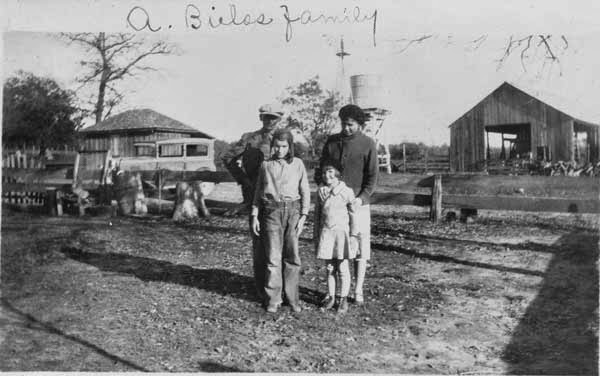
there. They weren't looking for a free ride. Weatherford resident Nila Bielss
Seale remembers those times as a girl. Remembers those people. Her parents, Mr.
and Mrs. Alvin Bielss were the Poor Farm's caretakers. Hired by the county from
the late 1920s through the early 1930s.
"It
was like a big home," she said. "All the people there were like aunts
and uncles. My mother and dad took care of them. They were doctor, nurse, and
psychologist".
The Poor
Farm consisted of two 160 acre tracts of land. The superintendent and his
family had a home out there. The house still stands, barely. There was a
barracks-like dormitory across the road from the family's house. Each Poor Farm
resident had a room off its center hallway. The dormitory had a large porch
across the front where the residents would often gather.
The Poor
Farm's large barn, smaller outbuildings, and a water trough inscribed by Nila's
daddy in 1923 also still remain. There's also a shack of a house off by itself,
being eaten alive by a tree, shared back then by a blind man and the farm's
Delco electrical system.

Joe C.
Moore was one of the early Parker County Commissioners. He reflected on the
court's thinking in starting the poor farm, in a Weatherford Weekly Herald
story September 21, 1911: "Editor: I desire to answer some of your
questions as to why the county poor farm was purchased, how used and what
revenue it produced. About 1881, soon after A. J. Hunter was elected county
judge, B.C. Tarkinton, Joe C. Moore, Frank Barnett and W. A. Massey were
commissioners. After an investigation, this court found that other counties had
farms that were a source of good revenue, a large savings to the taxpayers, and
a good thing in general."
"George
Abbott and wife were employed to superintend the farm with instructions to feed
and clothe well all inmates of the farm, and to give each of the inmates a task
according to their fittedness or ability."
The farm
was free and clear of debt after only three years. The commissioners additionally
used jail inmates to work at the farm. They received credit against their
sentences.

All
thirty-eight paupers under the county's financial support were then notified of
the day and time to assemble, to be taken to the Poor Farm. Steaming Nazi
locomotives pulling wooden-slatted cattle cars pop into my imagination as I
write this. Though that's probably not fair. I'm sure some thought, in Parker County
Apparently
only about half showed up, Mr. Moore tells us, "showing that the county
had been paying out money to those who had other means of support." No
such testing goes on today. Far as I know.
The Poor
Farm usually had between fourteen and twenty people living there at any one
time. Those that were able worked in the fields, gathered eggs, raised hogs and
cattle, milked or helped cook and clean back at the dormitory.
Aunt
Mary, one of the residents there, was a cook while the Bielss Family lived
there. The woman showed kindness to young Nila. "Aunt Mary made the best
tea cakes," she remembered. Once Nila's pet goat Billy, who followed Nila
everywhere, somehow got into Aunt Mary's room when the little girl was
visiting. Though Billy created quite a mess, Aunt Mary, known for her
organization and cleanliness, acted like nothing had happened.
Aunt Mary
grew tired in her later years and decided she was not going to help out around
the farm any longer. Her back was bothering her, she said. She could no longer
get around, she told some others. One afternoon, Nila's dad came up to the
dormitory's porch, where Aunt Mary was still feigning illness. He let a
harmless snake loose that promptly sought Aunt Mary out. Terrified of snakes,
she leapt from her chair and took off, promptly cured of her affliction.

"We
were almost totally self-sufficient," Nila said. "The people there
were very busy people. My mother and dad alternated each month in buying
groceries. Mother would get mad if the grocery bill was over twenty dollars for
the month (for about eighteen people). My dad butchered hogs after the first
cold spell and cured the meat. The cellar was full - the walls were lined with
fruits and vegetables my mother put up."
During
harvest season, when they would thresh the wheat, county commissioners would
pay people from Weatherford one dollar a day to work (during the Great
Depression). And people from town would come out, to help out - to get paid.
Nila's dad would salt meat and hang it from the rafters. When Poor Farm folks became ill, her mother or dad would sit up all night with them.
Nila's dad would salt meat and hang it from the rafters. When Poor Farm folks became ill, her mother or dad would sit up all night with them.
Nila had
a horse as a little girl. The commissioners apparently had confiscated the
animal from someone, to stop its abuse. "The horse wasn't quite
right," she remembered. "He would be perfectly sweet and
normal, then all of the sudden just go crazy for a little bit." Nila loved
that horse. One day she was riding him up by the big barn, through some old
tree stumps. The horse had one of his episodes. Threw her through the air and
onto the ground. Her dad was nearby. Thank goodness. Made sure she was okay.
She remembers this part. He told her to get right back up on that horse. So she
did.
The Poor
Farm owned a few other horses to pull the plows and wagons, even a couple of
Percherons at one point. Nila remembers her dad being partial to mules. These
teams would take corn to the gin in Granbury in a wagon, and would help harvest
the wheat. When it was ready.

Nila's
father often woke up at 3 a.m.
to begin his endless work around the farm. Near the end, most of the farm's
residents were advanced in age. Were not a lot of help.
"Daddy liked to whistle," Nila told me. "He was known for that. You could hear him, even at three in the morning, out there whistling." He was a deacon in the local church, where her mom taught Sunday School and played the piano. Before they were married, Mr. Bielss had to sell his beloved horse Penny. He needed the money. He wanted a proper wedding ring. He sacrificed.
"Daddy liked to whistle," Nila told me. "He was known for that. You could hear him, even at three in the morning, out there whistling." He was a deacon in the local church, where her mom taught Sunday School and played the piano. Before they were married, Mr. Bielss had to sell his beloved horse Penny. He needed the money. He wanted a proper wedding ring. He sacrificed.
Nila's
folks were good people, were hard workers. Nobody helped them out much except
for Moses, Mr. Taylor, and sometimes Aunt Mary. "Mr. Taylor, who was
blind, would want to help out more, but we were always afraid for him, when he
got around the big saw," Nila told me. He was a nice man, she said. Mr. Taylor.
Nila remembers
her family having a small record player. One day she and her brother Eldon were
playing "He'll Be Coming 'Round the Mountain" so loud that her mother
could hear it down the hill. They got into a storm of trouble. Before
electricity was common, the farm had a Delco unit powered by a windmill to run
a few things, like the single bulbs that hung from a few of the ceilings. The
Delco was located in same little house that Mr. Taylor lived in. The blind
gentleman.
Poor Farm
residents washed their clothes in big black number five wash pots. The man
named Moses kept pecans in a Maxwell Coffee can. He cut those pecans into
laser-perfect halves. Moses did. Moses was paralyzed on one side. Had a peg leg
that he made himself.
Nila told
me about Mrs. Baker, who'd been addled after being struck by lightning. It
stayed with her. Mrs. Baker. Whenever a storm approached, Nila's parents had to
comfort her fears.
Nila told
tales of a happy childhood at the farm. At the Poor Farm. Where her parents
took care of so many. Nila never lacked for anything, she wanted me to know.
Nila bottle fed her goats. Had a menagerie of livestock to keep her
entertained. She listened to Little Orphan Annie on the family's radio.
Around
1946 the dormitory building where the residents lived was moved to the 100
block of Throckmorton in Weatherford. It there served as a home for the aged.
The move was the end of the true operation of the Poor Farm. The building was
later relocated to Rusk Street ,
where it still stands.
I drive past it. Often. Though I've never ventured up to it. Wouldn't be polite.
After World War II, the federal and state governments increased social services for the poor and the elderly. For the nation. Not justParker County
I drive past it. Often. Though I've never ventured up to it. Wouldn't be polite.
After World War II, the federal and state governments increased social services for the poor and the elderly. For the nation. Not just
The Poor
Farm pauper cemetery still sleeps off in the woods. The place was forgotten
until the early 1980s, rediscovered by a group of hunters. It appeared to have
about forty adult graves. And one child's grave. No one knows for sure.

The
earliest documented burial was 1904. The lonely site had no fence. At that time
the county commissioners were considering selling the farm. The Parker County
Historical Commission persuaded commissioners to let them restore the dignity
of the cemetery. This, they did.
Later in
1986 a historic marker was awarded by the state, now visible from Tin Top Road . A
right-of-way was established from Tin Top to the cemetery. The Parker County
Abandoned Cemetery Association continues to maintain the cemetery, with the
help of donations. They do this, to this day.
I need to
finish this story. There's much to do. To prepare for. I feel nauseous. Unsure.
I need a
snake to scare me off this porch.
One man
living at the Poor Farm was insistent that he not end up in the pauper
cemetery. When the time came, Mr. Bielss buried him off in the woods. Wayne
Thompson, who ran a dairy on the property in the 1950s remembers three lone
graves off together near a lone tree, about a half mile away. This man's
presumed to be one of the three. But I'm not sure.
J. G.
Godley's death was particularly tragic. Godley died of suicide November 11, 1929 . Nila
recalls that Godley was once a wealthy man (related to the family that started
the Godley community to our south). He was divorced, was 87 at the time of his
passing. He apparently squandered his fortune and died a pauper at the farm. He
was always very bitter and depressed, Nila told me. Many times he pleaded with
her dad to kill him.
One morning the Bielss Family was having breakfast. Before sunrise. The cows down the hill started bawling. Her dad got his lantern. Said he'd better go check on what was wrong. On what was the matter.
One morning the Bielss Family was having breakfast. Before sunrise. The cows down the hill started bawling. Her dad got his lantern. Said he'd better go check on what was wrong. On what was the matter.
Mr.
Godley had cut his throat inside the farm's two hole privy. In the Poor Farm's
out house. He lay dead on the floor. The county death certificate lists no relatives
and no birthdate. The November 12, 19 29Austin . I never found her.
Nila
remembers Mr. Godley being buried outside the paupers' cemetery fence by her
father. County records show his final resting place as Oakland Cemetery
The Poor
Farm Cemetery has one of the highest ratios of unmarked graves in Parker County
Association
members Mary Kemp and Billie Bell spent long hours going through records trying
to learn the names of those interred at this cemetery. Mary helped me with this
story. Nila was its ringside witness.
I don't
know how this story comes out. The Poor Farm. Parker County
We could
be in for the surprise of our lives.
The Poor
Farm woods south of Weatherford probably hold this nation's answer. The souls
in that graveyard. The whispers in those trees.Those times seem so foreign.
Listening to that little girl. To the slip-sliding past. Our future's out
there. A cradled secret, walking around in the faded front overalls pocket of
another time. But those folks aren't talking. Not today. Not to me.
SUGGESTED CAPTIONS
Depression-Era
residents sit on the front porch of the Poor Farm Dorm.
Nila’s
Family near the Poor Farm barnyard.
Subscribe to:
Posts (Atom)