Everything Matters

Everything Matters
Zim's Bottling of Strawn
Showing posts with label Strawn. Show all posts

Saturday, March 22, 2014

The Strawn Sand by Joe Martin

Memories of Strawn by Joe Martin
Introduced By Jeff Clark

The below “The Strawn Sand” manuscript describes what life was once like around Strawn, Texas. It wanders a bit, as good stories will. The words were written by Joe Martin. Martin died several years ago in Sinton, Texas. I can’t exactly remember who handed me this. It won’t be long, now.

This work is longer than what I usually share. There is more information, more nuance contained in these pages than a quick reading will reveal.

It’s been many months of Sundays since my high school American History class (or Texas History, for that matter). I remember many of the topics Mr. Martin shares. I just wasn’t taught that this pivotal American history had subchapters along the road between Fort Worth and Abilene. Mr. Martin successfully ties Pancho Villa, Mother Jones, the World’s Oldest Profession, William Jennings Bryan, the Wobblies, and many other topics your history teachers quizzed you about to the same real estate that now boasts sprawling game ranches and Mary’s Café.

I wish for once you could stand across the desk from me, as I finish typing this. I’m holding a yellowing sheaf of 17 hand-typed pages with “by Joe Martin” at the top. Staring back at me. There are penciled corrections throughout, fixing one thing or another. I hope Mr. Martin held these same pages once, as I am now.

It’s not the Holy Grail. Or maybe it is. A small piece of it, anyway.

I haven’t changed anything in his story, haven’t “corrected” or edited any of the sights or events Mr. Martin lets us see. I wasn’t there. Joe Martin was.

It’s unclear to me when Mr. Martin’s tale was written, though there are clues. I won’t spoil it for you. If you choose to make your way through his pages, please do him the honor of reading them slowly. What appear to be mistakes might be. Or maybe not…

One sentence knocked me down.

Or maybe three.

Including Mr. Martin’s story is a departure for the Texas Tabernacle. I didn’t write these words. One extremely tough night last week, I looked around “underneath” the dirt floor tabernacle’s timbered supports holding the weathered tin roof aloft and remembered I wasn’t alone. Hopefully, this place will be more of a conversation in the future. More like at Alameda Cemetery workings have been for over 120+ years, valued friends and kin catching up. Reconnecting. Carrying the “life” of a place forward. We hope, perhaps pray, that the circle is yet unbroken.

“The Strawn Sand,” by Joe Martin (Part One):

            “Oil was struck near Strawn in 1915. This was a shallow, long life, high quality oil. Sand drilled with standard or cable tools. One power house pumped a number of wells on rod lines.
            Before oil was struck, Strawn was a coal mining and farm and ranch center. It was in an industrial area or triangle of the main Texas coalfields in the coal boom days. Thurber was the largest town of this triangle with the largest payroll….Two miles north of Thurber was Mingus or Thurber Junction. A railroad subdivision with coal chutes and car repair shops. Along the railroad and dirt or cinder road from Thurber to Mingus was a settlement called Grants Town. Four miles east of Mingus was Gordon. Three miles west of Mingus was Lyra or Mineral City. A coal mine town two miles from Lyra west was Strawn. Strawn was seven miles northwest of Thurber. In this area twenty-one coal mines were sunk. The Thurber Company sank sixteen, number one to twelve, number thirteen skipped, then one to four. Strawn sank four at Lyra, one at Strawn.
            Everyone in mining except the bosses belonged to the U.M.W of A. or United Mine Workers of America. District twenty-one, Texas, Oklahoma, Arkansas. The Strawn mine was named Mt. Marion. Lyra mines numbered one to four. Strawn coal had a large company department store at Strawn. The Lyra store was grocery, meat market, dry goods and hardware store and office. The Strawn store was one block long, half block wide with office, dry goods, furniture, groceries, meat market, hardware, stock feed and funeral home, the famous Strawn merchandise company. Their ads said from the cradle to the grave. They owned a lumber yard under a different name.
            The company had its own money which was accepted in all private stores in the area as cash. It was in brass and metal coins in five, ten, twenty-five, fifty cents and one dollar pieces. The company had a payday once a month. The employee sent a statement of deductions from house rent if he lived in a company house, bills owed company store, union dues, even money due church if he was Catholic and how much due him in U.S. cash. On payday employees with good rating could buy from company stores on credit or he could draw company money before payday if he had wages due. Peddlers of all kinds of goods and farm produce would accept company money for such trading.
            At the company store in Strawn, the cashier sat up in an office overlooking dry goods and furniture on one side and grocery, meat market, hardware on the other side. The clerk would send cash and the bill via wire trolley to cashier. She or he would ring up sale on register, put in change, and return to clerk.
            The company store was the meeting place for the townspeople. There was a porch and sidewalk in front and large plate glass windows. The doors were open in the summer. There were boxes of slab cured bacon near meat market counter.
            The town was full of hound dogs always hungry and looking for food.
            The store manager drank heavy. One day a hound ran in and grabbed a slab of bacon and ran for the front door. The manager grabbed a slab, threw it at the dog, missed him but hit the big window. There were many such incidents in the company store or in Strawn. Us kids would go to the company store if we had a five-cent coin, either U.S. or company and buy a grab bag of nickel candy. If lucky there would be a U.S. nickel in the bag.
            The company store had a brick building at the edge of town where dynamite and blasting powder was stored.
            The company store also sold all types of miners supplies. The vein or seam was small or 30 to 40 inches of coal. The digger had to work a lot on his knees or on his back. He would dig the bottom slate from under coal with sharp 2-edge picks or drill holes and shoot with blasting powder. The bottom was from 12 to 20 inches thick. In Thurber mines with electric cutting machines did this work. The mines were called “long wall” or British type.” In bigger U.S. mines the type is “room and pillar.” Forty feet of seam is cut or shot, then 40 feet left for pillar. Later this is taken. The top rock was shot down with dynamite just high and wide enough for rail tracks and for mule or motor.
            Each digger has numbered brass checks he put on the car of coal. When the car was dumped on top, the weight was credited to that number. At the end of the shift the digger could see on daily sheets, number of cars and weight to his number.
            A check puller, usually a boy 15 to 17 years old, took check from car, put check on board in weight room, called the number to weigh boss and union check weigh man All on top in the tipple. The swift steam hoist pulled cars to the top in steel cages. One cage descended as the other cage ascended. The operator sat on high stools in the engine room with large windows open to see, but he watched large dial indicators that told him where cages were at all times. One of the cagers on the bottom pulled a lever which blew a small steam whistle on top near the operator or engineer, as he was called. One blast meant coal, two meant rock, and three meant a man wanted the cage. The engineer answered three blasts with one blast from the big whistle. After the man entered the cage, the cager blew a little whistle one time. The cage went up.
            Men were allotted a cage only at 10 a.m., 11:30 a.m. and 2 p.m., except in an emergency. The big steam whistle blew only at 7 a.m. to start lowering the men, 10 a.m., 11:30 a.m., 2 p.m. and 4 p.m. at shift’s end. Then 7:30 p.m. three long blasts meant mine worked next day. And 5:30 a.m. three long blasts meant work that day. Any other blasts any time meant disaster and all off duty men to report to mine. The U.S. Bureau of Mines taught first aid and safety to mine rescue teams.
            The companies and union helped in all ways and encouraged safety first and correct first aid work. There were six men to a first aid team with splints, bandages, stretchers, etc. These were almost as good as a doctor on first aid. Meets and contests were held and the winners given medals and prizes. Then winners went on to district and national meets…{Ed: To be continued}.

“The Strawn Sand,” by Joe Martin (Part Two):

            …The European miners lived almost as they did in Europe. They spoke their native tongue, ate food of their native land and kept religion and customs and dress of their native lands.
            After a death, there would be a wake and much drinking. The Poles and Slavs would dig a grave at night. Everyone then dug the graves for all as token of help. The corpse would be brought home and friends would sit by open coffin until burial time.
            A wedding would last for days with drinking, eating and dancing. Among the Poles and Slavs, the bride would dance with all who paid a dollar. And in the yard a plate was set up and for one dollar men would throw at the plate with a silver dollar. If he missed, the dollar was the groom’s. This money was used to set up housekeeping for the couple.
            They were good miners and citizens and the young were fine athletes. The Italians built outdoor bake ovens of brick and stone. A wood fire was put in the oven until the right temperature, then oven cleaned and bread and meats baked.
            The Italians played an outdoor bowling game called “bocce ball” with wooden balls. The Italians were fine musicians. The Italian brass band at Thurber was the state’s finest. Many races and nationalities were in Strawn, but no Negroes were allowed there.
            There was a cotton gin near the mine owned by the coal company and supplied wine steam from the mine’s boilers. Another firm had a flour mill and feed mill in town. Strawn had all needed business stores and shops. One of the main businesses was the four large saloons. There were many dry towns in the area and customers came via rail or horse. The saloons opened at five in the morning and closed at midnight. No women went into saloons. Children went in with fathers and were served bottled soda pop. Coal miners are heaviest of all drinkers, but they do not go on the job drunk or bring booze to the job, for the company fired them at once and the union backed the company.
            There were many fist fights among drunks and funny antics. One warm day a drunk came out of the saloon, untied his horse, turned him and then started to whip the horse. The horse was hitched to a buggy. The drunk wore a hat and had a large mustache. The horse barely missed the mustache, but sent the hat sailing in the air.
            A blind piano tuner would come to town to tune pianos. He drank heavy. Another drunk would lead him to jobs. One rainy day both were wading through the mud street instead of using the cinder sidewalk.
A large Slav woman with grown sons and daughters had a small husband called “Spider.” Almost every Sunday eve “Spider” got drunk and his wife and two youngest daughters brought him home. At the bridge almost home, he would pull loose from the girls and defy his wife. She would turn back and kick him so hard to lift him in the air.
            A confederate veteran lived near us. On Southern holidays he would dress in his gray uniform with rifle and confederate flag and march downtown singing “The Pretty Little Girl I Left Behind Me.” {To be continued.}

“The Strawn Sand,” by Joe Martin (Part Three):

            My mother belonged to a Campbellite Church. One night we were in church in summer with an elderly lady and her daughter. The window and doors were open. The preacher was on the rostrum. The lady’s husband came in drunk. He got a chair and sat on the side of the preacher and kept his straw hat on. He rolled a cigarette, lit it and with his hat in front of his face he puffed away. His wife and daughter scolded him after church.
            A farmer and wife and grown sons lived south of town. They would come to town, the sons on horseback and the old man driving mules to a wagon. In town they went to the saloon to get drunk. One time there was a tent show with stage plays near the saloon. The old man and his sons got drunk, bought front row seats. On stage the villain appeared while the hero was gone. He tried to grab the heroine. One of the farmer’s sons was ever the gentleman. He ran out to the wagon, got a single tree and went on stage and said no lowdown skunk would bother a lady while he was present. The constable went and took him to jail…
            One summer a Baptist preacher and a Campbellite preacher had nightly debates on religion under a tent for two weeks.
            There was a Baptist church, Methodist church, Presbyterian church, Catholic church and Campbellite church in Strawn. The Campbellites split over music in the church. Then the holy rollers came in. There were also a few infidels who read Bob Ingersoll.
            The main political party was the Democrat, but there were a few Republicans. And a large number of Socialists who read The Appeal to Reason from Girard Kans, and The Rip Saw from Dallas. Socialist speakers were brought in. A famous woman Socialist, Kate Richards O’Hara, spoke at Thurber. And “Mother Jones” famed miners organizer spoke at Thurber. When the United States entered the first World War a secret group came to Strawn and Thurber called the Farmers and Laborers Protective Association. Members took an oath to resist the draft with firearms. This is treason, so federal agents arrested the leaders who were tried in federal court in Abilene, Texas, and sent to federal prison.
            The young members joined military service or waited for the draft. Coal was needed in the war effort. There was a large yellow board at each coal mine where names of miners were placed who were accused of being slackers. Young miners so accused had their names sent to the draft board. At New Thurber number two mine was a cashing head gasoline plant. At Fort Worth there were three flying fields where American, Canadian and British flyers trained. The airmen would fly and light near the plant and put gasoline in their tanks. One day a plane lit in a wheatfield of my father’s. A plane was a sight to folks then. The crowd trampled and ruined some grain. My father complained to the postmaster and soon a government official came and paid for damage. One of the British airmen who flew to the plant was Vernon Castle of the famous ballroom dance team of Irene and Vernon Castle.
            At Fort Worth was Camp Bowie, an army camp where the 36th division of Texas and Oklahoma troops were trained before going to France in World War I. Most drafted men were sent to San Antonio or Camp Travis to join the 90th division national army or the Army of the United States. At Waco was Camp MacArthur, Michigan-Wisconsin troops. At Houston was Camp Logan with Illinois troops. Negro troops at Camp Logan started race riots in the war. The leaders were taken to Fort Sam Houston at San Antonio and tried by Army court and hung.
            About this time trouble between the United States and Mexico sent both regular army and the national guard troops to the border. After Pancho Villa raided Columbus, New Mexico, General Pershing’s troops went into the interior of Mexico. Troop trains passed through Strawn very often. The soldiers would be waving and singing and holding up bottles of beer or whiskey. And they would throw out pieces of hard tack, a hard bread or cracker. On them would be soldiers’ names and army address, or a clip of cartridges from an army rifle. The railroad put guards on railbridges west of town. These were for drunks and loafers.
            One older guard did more fishing, hunting and pecan picking and drinking than watching. Their camp was near two railbridges. The locomotive engineer would blow an engine whistle for guards to wave an all clear signal. One night he blew for the signal, but the old man could not find a flashlight so he struck a kitchen match and waved and said as the train entered the first bridge, “We’ll soon know if the other one is still there.”
            The trouble with Mexico passed and troop trains rolled east and north to ships overseas as the nation entered war in Europe. But now they were tanned and fit and more serious.
            The War’s armistice was signed on the 11th hour of the 11th day of November, 1918. By then the Spanish influenza was a national epidemic.
            By 1915 the Thurber Company struck oil near Strawn. Before this their coal drilling rigs had found gas and oil as they went west. In fact so much gas was found in the new number four of Thurber, worked ceased. This was farthest west of all the area’s coal mines.
            The oil strike changed the area in every way. Oil firms came in with contractors and workers and new families caused a building boom.  Folks came in, such as gamblers, heist guys, women of the world’s oldest profession and their panders. Drilling continued in every direction from Strawn. Strawn was nearest the rail station and oil supplies were unloaded for nearby fields. These were shallow fields from 1500 to 4000 feet deep. The rigs were star or national machines or Fort Worth spudders or standard or cable tool rigs.
            The crew was only a driller and tool dresser who worked 12 hour tours or shifts. But a casing crew of 5 men was used when pipes were set. These crews bought the casing pole and never slipped a set of tongs. They also worked 12 hour tours but got double time on wet jobs where a well flowed. The casers worked for contractors who furnished a car casing pole and never slipped. He paid casers after deducting 20 percent of wages. A casing contractor at Caddo drew pay from oil companies and left town at night without paying his men. Some of these wells only pumped 2 or 3 barrels a day. But it was high grade crude. A central pump station pumped several wells with rod lines. In 1917 the Thurber company struck oil at Ranger causing one of the nation’s biggest booms of all times.
            Rigs touched each other. Their streets were so boggy, people paid a dime to ride a sled pulled by horses across the street. Gambling houses and bootleg joints were all over town. And the largest red light district I ever saw, and I had seen those in Galveston, Kansas City and Chicago. The Scarlet sisters came to Ranger from world over. Murder was often in the news.
            The mud brought mules and horses, even oxen to Ranger. Big horses and mules with fine harnesses and rings and bells were seen. The oxen pulled 8-wheeled wagons and there were cat tractors that pulled two to three 8-wheeled wagons in trains. There was a big lady who rode a big white horse. She was armed with a bull whip and pistol and watched over the horses, mules and oxen. Some said she worked for the Humane Society.
            In 1916, the oil workers at Strawn joined the union and asked for better pay and shorter hours. But they failed to get union contacts. The I.W.W. or “wobblies” were also active among oil workers in the area, mostly among pipe liners. Some pipe line superintendents were wobblies and so were many stabbers.
            In that day the oil firms furnished meals, beds and shower baths to workers so the workers expected good food, clean beds and shower baths. The big oil firms had inspectors who drove unmarked autos and ate the same food as the workers and inspected the beds and showers. Three railroads were laid from Ranger to Breckenridge in Stephens County. One from Cisco to Breckenridge, one from Ranger and one from Eastland, which joined the Ranger railroad at Breck Walker, six miles south of Breckenridge. {Ed: to be continued.}

“The Strawn Sand,” by Joe Martin (Part Four):

            The Eastland Railroad was built and owned by Ringling Brothers of Circus fame. Nearby Cisco was where Conrad Hilton of Hotel fame got his start as hotel owner of a small two-story brick hotel called Mobley Hotel near the railroad station. Cisco also had a large Humble oil camp.
            In 1920 the world champion baseball Cincinnati Reds trained at Cisco. They were World Series winners in 1919 in the Black Sox scandal of thrown games. And in 1920 the Columbus Red Birds of three American Association played the Cincy Reds – in Ranger, where the Red Birds trained. In that game the Cincy third baseman, Sammy Bohne, hit 4 home runs over the right field wall.
            Strawn never lacked from show or other entertainment. There was the Opry House and at one time two open air dome movie shows. There were traveling shows under tents and shows at the Opry House. Every summer Mollie Bailey Circus showed there. Once Campbell Brothers Circus, one of the largest railroads showed, gave two performances in Strawn. And in 1922 the Gentry Brothers Circus showed there. The minstrels did too. The minstrels always gave a street parade in bright red uniforms with a brass band with slide trombones loud and clear.
            They were an impressive sight. The carnivals came too. Some had wrestlers and boxers who gave money to anyone who stayed so many rounds or minutes. The Pole and Slav miners gave good account against these showmen. One Slav miner had met Dr. Roller, the famed wrestler. Another Slav miner became lightweight champ.
            Baseball was the favorite sport of miners. The Thurber miners were the best semi-pro team in the Southwest. They had a left-handed pitcher who, it was said struck out 26 at Trinity University at Waxahachie, but lost the game as the catcher missed the third strike. The Detroit Tigers trained at Waxahachie. They signed Charles “Chink” Watson to a contract. At Shreveport he struck out Babe Ruth twice in a spring game. Strawn had Fred Dealon Johnson, a strong right hander, who shut out Mineral Wells twice one Sunday. He went to Cisco in the West Texas League. Then he went to San Antonio of the Texas League, then to the New York Giants, then back to the minors for 15 years and back to the St. Louis Browns. Paul Richards said Fred Johnson “learned him” all he knew about pitching.
            The only hurler ever to bother Strawn was Pete Donohue of Libby Packing House of Fort Worth. Pete signed with the Cincy Reds.
            The traveling road clubs played Strawn. The most famed was the Boston Bloomer Girls. They traveled in three railcars and stretched a canvas wall around the playing field. All the Bloomers were not girls. They key players were top men. They wore wigs.
            After World War I Strawn High School started football in 1923. They beat the Oil Belt teams and also Fort Worth and Dallas. They also beat Cleburne in bi-district game, but lost to Wichita Falls in the finals. They had 13 men and 11 uniforms in shows.
            The Chataqua Circuit came to Strawn. They had top talent plus famed speakers such as William Jennings Bryan who was Secretary of State in the Wilson Administration.
            These were the days of the great American hobo or knights of the road, on the Weary Willies. They were well treated and fed good in Strawn, for the coal miners traveled via freight to other coal fields. The hobos had monikers or nicknames. These were carved on rail water tanks and the direction they were traveling. The most famous was a No. one, also an author and back to shows.
            Once the George J. Loos carnival came to Strawn with Booger Red’s Rodeo and the Forty Nine Dance Hall girls came to Strawn in a tent. They danced on wooden floors to the tune of a piano played by a negro called the “Perfessor.” They danced with any male with the price of the dance, fifteen cents each dance. One time a fight started in the tent and the tent pole was pulled and the tent came in on all under it.
            One carnival had thrill motorcycle riders. The crown would be on the outside of the wall and riders would ride motorcycles up and around the straight up walls. One daring rider was called Crazy John…{Ed: to be continued}

“The Strawn Sand,” by Joe Martin (Part Five):

            Mount Marion mine at Strawn was 412 feet deep. Number four at Lyra was over 500 feet deep. The vein pitched down as it went west. At Strawn there was a steam engine that pulled the wire line west. An electric locomotive pushed as the engine pulled. The brakeman rode the first car of the trip. He was called roperider in Oklahoma mines. Shot firers went down in the evening, after day shift finished. The loader fixed shots and the shot firer shot them. He set off each one then went to parting to wait till all went off and to wait for the buddy shot firer. They said in Oklahoma shot firers were paid $50 a shift and funeral expenses.
            The mines in the area employed from 200 to 400 men and produced 500 to 1000 tons daily. Most of the coal was used by the Texas and Pacific Railroad. But some went to other railroads.
            One of the thrill shows at these carnivals was the motor dome. This was a circular, vertical wall in which men on motorcycles would get up enough speed to ride around it and defy gravity. One carnival which came to town had a wrestling and boxing show which has a lady wrestler. She was a fair wrestler but no match for the young miners. The best carnival to stop in Strawn was the George J. Loos Shows which played the Fat Stock Show at Fort Worth.
            This carnival had what was rated as the top rodeo show and top rodeo family in all Texas history. This was Booger Red and his sons. They had fine stock and horses and had no peers as riders and real sure enough Texas Cowhands.
            The Opry House showed movies when no traveling stage shows were in town. These were mostly three reel show, one reel comedy, and two reel plays, usually Cowboy or Civil War stories. The Opry House had a balcony called Buzzards Roost. Only males would sit up there as some would chew tobacco and spit on the floor.
            Strawn also had two air domes or open air movie shows. The Opry House then started showing five reel feature films. And the serial or continued movie started. An episode would be shown once a week. Among the first were “The Broken Coin” with Francis Ford and Grace Cunard. And the “Perils of Pauline” with Pearl White and later the “Million Dollar Mystery,” and Helen Holmes in the thrilling rail road serial.
            One Friday night at the end of a serial where the heroine was left in a dangerous situation and the script said “To Be Continued next week,” one patron was disgusted, he said “aw” then uttered an unprintable word out loud. This was before talking pictures, so everything was and all talk was shown in print on the screen. Even after I was grown, there were silent movies.
            When I was in Henrietta, Oklahoma, a coal mining city, there were some former Strawn miners there. One, a young French man invited me to a movie. The story moved into Chinatown and some Chinese writing was on the screen. I asked Frenchie, as we called him, if he could read the writing or characters. He said, “No, but if I had my coronet here, I could play it.”
            The Strawn Opry House had a gramophone with a horn they played in the evenings before show time from the balcony. There was a piano some one would play during the show and some times the local musicians would form a small orchestra and play before the movie. Later and electric player piano was put in.
            The first big super film made was shown at the Opry House. It was “Birth of a Nation.”
            One of the best and cleanest forms of entertainment that came to Strawn or any other small town was the “Chataqua.” This was a tent show with a variety of features of high class talent and even featured noted personages and speakers such as William Jennings Bryan, the “Golden Orator,” who later became Secretary of State. The Chatuqua was an entertainment bureau that brought culture to the small towns like Strawn. The folks got their money’s worth at the Chatauqua.
            One of the big drawing shows at the Opry House was the musical comedies with the girl chorus which were leg shows. In those days a girl or woman’s bare legs were not seen in public. Even in bathing, the women wore long bathing suits. In these shows the chorus girls wore short tights and exposed part of their leg. The men and older boys would always find enough money to view these shows and then hum or whistle the tunes for weeks after.
            Another show which attracted the males were the Forty Nine Dance Halls. These were tents or canvas walls with a wooden dance floor, a piano player, dance girls and a bar. But the bar would only serve soft drinks. After every dance the manager or bouncer would shout, “All right boys, let’s decorate the Mahogany.” He meant for the male dancer to take his girl and buy both of them a small drink at the bar. These drinks were small and cost two or three times as much as they would at regular fountains. One such dance hall tent was torn down in a fight between young miners and the dance hall men. Strawn had a nice dance hall run by a miner. One dance hall had been built on the far north side of town and some of the neighbors did not like it so it burned down one night in a mystery fire. But then a big Polish man built a dance hall on the south side of town and promoted dances there. He was a big man and able to take care of any trouble. One night a little Irish man who had two many drinks caused some trouble. The big Pole went over and got the little Irish man by the seat of his pants and carried him to the front door and threw him out. The little Irish man found a half brick. He yelled, “Come out, come out and I will part your hair with this stone.”

To be continued

{JDC: To my knowledge, it never was…}

Friday, March 14, 2014

The Lost Road to California

The Lost Road to California?
The Future of America

By Jeff Clark

Sometimes stories are bigger than you can grab hold of. This one's like that. I met eighty-four-year-old Luther Fambro on his place last Friday. A nice man, wise, gracious.
We talked enough for several stories, spent most of the afternoon riding around. The one tale still rolling around in my head is about the abandoned wagon road he showed me. Let me back up a step.
When I was working on the Alameda story, I ran across a diary that RIP (“Rest in Peace”) Ford wrote as he rode through this part of Texas around 1835. He turned his reins north, then all of the sudden took off west. Went up a valley to avoid high mountains, arrived at level land on top, then continued toward the sunset.

I've always suspected he went up Bear Creek Canyon, south of I-20's Ranger Hill (aka Thurber Hill, if you’re old enough). Any breadcrumbs Ford’s party left behind marking their route are gone. Land in this part of Eastland County more closely mirrors Palo Pinto County, giant cattle ranches on wide open, rougher-than-a-cob land. There were tough Allens in this country, Woods, McDowells, Stuards, Hinksons, and more.
The mystery wagon road leading up the canyon has long since been abandoned. A series of massive bridge headwalls of stacked native stone, save one of reinforced concrete. Huge eight by eight timbers, preserved like they were cut yesterday, like those used during Hogtown’s oil boom lie in the brush. Smaller boards I take to be the old deck of each bridge hide here and there. This old road crosses Bear Creek seven times in three miles.

Back before water wells, stock tanks, oil exploration and other man-driven alterations to area groundwater, the streams and springs often flowed year-round. The erosion from now-dry springs and rivulets is still carved into the sides of this beautiful valley.
As we ascended the valley shadowing this old road, I was struck by the gentleness of its grade, far less steep than modern-day I-20. A wagon and team could have made it up this valley. There would have been places to camp, small pastures to graze tired teams, forests (then) of oaks, now crowded by cedar and mesquite. Abundant cover and water would have fed dinnertime game.

We pass where remnants of a whiskey still were broken apart, probably by “revenuers” (revenue agents), I presume during Prohibition. Copper tubing and sundry components were strewn all over the ground, now long-since vanished. The still was hidden about twenty yards off this road.
My 1917 Soil Study map for Eastland County betrays this road, though there was no indication that it was a county, or regional thoroughfare. It intersected the north-south road that ran through eighteen gates connecting Strawn to Desdemona before Highway 16 was built, not far from Mr. Fambro's house. It appears to come from a much larger road from Thurber. It trails west, toward the Crossroads and Russell Creek Communities.
As we ascended this lost wagon trail, I couldn't help but wonder if my Russell Creek Community friends from the 1870s had ridden their horses, had driven their teams up this route. Russell Creek’s ghost town front doorsteps sleep only another five miles distant. I couldn't help but feel a tug, knowing I was seeing country they saw, at least in broad outline. Knowing their wagon wheels creaked up the same ruts our modern day rubber-tired pickup truck now climbed.

After returning home, I checked with some friends who I thought might remember the wagon road, might be able to tell me if this was the road to California. Highway 80 was commissioned in 1926. It surely replaced this road. Folks around Ranger told me that a traveler would have taken a northern route to Caddo, then east toward Fort Worth. The hardier could have gone down the more exciting narrow path along the T & P rail bed, descending (like a rock in some places) the perilous wilds of Wiles Canyon toward Strawn.
This land could have been made "off limits" by some long-ago six-shooter-toting landowner, arresting public use of this road. Ornery first and second generation ranchers ran cattle up and around this stretch of country back then.
I would’ve written the road off as a neglected old wagon trail, common in this part of Texas, but for the "established", engineered look of these bridge headwalls, some wider than twenty feet. A lot of trouble went into building this road. The path had to have been a major east-to-west-route, at some time, for some major reason.

I've included a couple of photos, in case anyone remembers. I suspect my storytellers from that time have passed on. Why does any of this matter? Old wagon roads knitted this country's west-moving settlement into a young nation. This dusty road undoubtedly carried daily trips up to Russell Creek's Church of Christ, or to the new Ranger oil fields, or from Thurber's never-quite-opened mine at its base.
The T & P had laid the train spur’s track for the next coal mine here, had built the lake, built fourteen houses, according to 1917’s map. But as they were about to sink a shaft, Ranger's star-crossed oil boom hit. The coal mine never got dug.
Could this have been one road to California? Could this now-abandoned path have carried the dreams of a much-braver nation to its far coast, birthing settlement along the way? What picturesque characters might have slid up the road slicing these two mountains, from 1835 to as late as the 1920s?
Topography would have almost forced one to take this route. Did the Caddo peoples, the Comanches, the earlier wandering Natives whose tribe names have been lost walk this path? Surrounded for miles by steep mountains and cliffs, it is almost certain.
Mr. Fambro's dad was Truman Conner ("T.C.") Fambro, who lived for a time up around Wayland, north of Ranger in Stephens County. He had family in the Acker Community, across the big mountain, where my great-grandparents lived, and suffered, before coming to Cheaney. Around WWII Luther's dad started buying tracts down here around Bear Mountain. The communities of Marston and Mountain had vanished by then. Gourdneck and Tanner were sinking fast.

Some thought his land purchases ($16 - $22/acre) were outrageously over-priced, ill-advised. That was before Highway 16, or I-20. Before land was bought for "leisure”. Ranch land had to cash flow, back then.
Luther Fambro moved back on the family place about 35 years ago. While in high school he worked for Mr. McKerrin in Breckenridge, at a men's clothing store. McKerrin was good to him. Young Luther'd work at the store first period, then after school and on Saturdays (after a tough Friday night football game).
He played "end", there being no tight ends or wide receivers back then. World War II called him away for three years, going here and there as some commanding officer thought fit. When he returned, he ended up at North Texas in Denton on a full scholarship, aided also by the GI bill. Fambro's loyalties to the school are evident, a bright green North Texas flag greeting you as you enter his spread.
Remember, I grew up in the city. Still, some parts of rural economics don't make sense to me. I asked Mr. Fambro how a person could make modern $2,000 per acre land prices work, running cattle or maybe farming. I can't even almost make the math work. If a deep-pocketed person buys land for recreation, pays cash as an investment, then the numbers can work, after a tax-code-twisted fashion. Tax-free exchanges, deferred loss and well, all that wealth's got to go somewhere.
This tough land can prudently support one cow every twenty acres. $40,000 of land, for one cow. Doesn't paying more than a few-hundred-dollars per acre doom one's ranching enterprise? How do couples starting out, wanting to farm or ranch get going? They'd have to inherit an operation, earn a great income from some paycheck job, or borrow the mother-of-all land loans. Even then it might not be enough.
Mr. Fambro has worked hard his whole life. Shared that he wasn't always what he called "well off". He had a stroke in 1992, making it tough to work his land, and the thousands of ranching acres he'd leased to add to the mix. Still, his hard work seems to have paid off.
His place doesn't boast one of the gleaming monster homes springing up in this part of rural Texas, perhaps, but he's living on ancestral land, some family nearby, happy, secure in the strong beliefs that brought him here. We drove though gates, passed different breeds of cattle. He counted them, “took them in” through his front windshield. He's still working this land. The man helps out some groups he's fond of, attached to, out in the world. He's "seeing to" the places he came from, as my granddad would’ve said.
Turns out Fambro lived in Richardson once, north of Dallas, a couple of blocks from the high school I graduated from. He coached at powerhouse Highland Park, who my Richardson School attempted to play each season. We felt like we really stomped Highland Park, if we lost by 14 points or less.
I'm staring in frustration at my notes from Mr. Fambro's kind visit. There are ten more stories in there, easy. I will share more, as this tale continues to unspool. That old road has gotten under my skin. Like our country, too many have forgotten where this wagon road came from, and most don’t have a clue where it’s going. But we know by looking at this old road, that once, whatever rolled along its path was significant.

I hope things are good with you.

Tuesday, March 4, 2014

Hohhertz Story

Hohhertz Oil Field Camp
Invites Past into Present
By Jeff Clark

            Folks who say Texas history never dies haven’t driven enough dusty back roads. One passes old foundations, stacked rock walls and “out of place” fence rows knowing that Lives unfolded out there.
            Lives that were never written down.
            Teams of archeologists, historians and forensic investigators could descend on the place, I suppose. Years and millions of dollars later they could piece together a glossy paper guess about the people who lived out there.
            But without those people, it’d still be a guess.


            I was told about the Hohhertz Camp, a Texas & Pacific Coal & Oil Company camp located on Hohhertz Road, straddling the southeastern border between Palo Pinto and Stephens Counties. I drove out.
            I didn’t see a lot.
            Like others from my instant-messaging generation, I don’t have the time or that team of specialists to help uncover all the lost places I hear about.
            All those clues calling from behind barbed wire fence rows.

Hohhertz Camp was started by the T & P Coal & Oil Company sometime before 1917. Billy Gordon and his dad W.K. of Thurber fame were said to be hunting around Hohhertz when the McClesky oil well blew in that year, setting off the short-lived Ranger Oil Boom. They returned to their car, finding a note on their steering wheel announcing the news. That’s the earliest date I could verify. Seeping oil bedeviled several coal mines to the south and southeast of the Hohhertz area in the late 1800s, considered a nuisance by mine owners until Spindletop taught them better.


Oil camps were temporary settlements where men drilled then pumped crude oil from the ground. The T & P believed in owning everything – the land, the store, families’ homes, the school, the office, the recreation hall, probably some tents. Think Thurber, but smaller, more mobile.
There might’ve been 250 living in the community near its beginning. When the wells were all drilled, this number tapered down over the years.
Towards the 1930s, Hohhertz Camp changed from drilling, to mostly pumping and maintenance. Make sure the oil continues to flow, but we’ll be in Midland or Odessa if you need us.
I went through lots of folks who held small pieces of the puzzle until I happened upon the Sinclair girls – Ellen, Norma and Billye. They grew up there. And then Stanley Bowen. His childhood memories were shaped a few yards down the 1 x 12 wooden side walk from the Sinclair house.
I pulled up a chair. Took out a pen.


Hohhertz Camp was a community in every sense of the word. The first row of five or six identical company-owned houses lining Hohhertz Road faced south, just across the Stephens County line.
There were three rows of these houses, maybe 18 total. There were four or five more homes scattered south into Palo Pinto County along this road. Bowen remembered about 18 families in the 1930s and 1940s.
The Sinclair girls’ daddy William Bryan Sinclair probably worked in Hohhertz longer than anyone, he maintaining a pump station down the hill through the trees adjacent to the Hohhertz Ranch until he retired in 1965. Sinclair could fix or build most anything. Rattlesnakes slithered the countryside then and now. Below that hill sat a huge gas engine (called “The Power” by residents) that ran 15 – 23 rod lines powering pumping oil rigs in the fields.
The Sinclair house started with two bedrooms, but Mr. Sinclair added a third. They had a bathroom and shower, living room and kitchen. Their yard had cut grass and rock-lined flower beds. If you’ve never been out to that part of the world, it’s rough rocky country.
The Sinclairs had a garden.


The camp houses boasted natural gas and indoor plumbing, but no electricity until the REA years later. The Wirt Goodsons owned a Maytag washing machine, though they had to heat the water in big boiling pots and “prime” the clothes with the rub board first.

Toward the 1940s and 1950s there were about 20 oil wells on the 800+ acre Stuart Place, the southern area of Hohhertz. Lone Star Gas had a camp out there somewhere too.
Early Hohhertz Camp was said to have a one room school on the south side of the road (below the water tower) that closed around 1930. The Sinclair girls remember bus rides to Caddo through 6th grade, then junior and senior high school students being bussed to Breckenridge.
Families paid rent. Twelve unmarried pumpers lived in a bunkhouse where meals were served. A party line phone connected these homes across the cattle guard, a T & P company sign welded overhead. The elevated water tank looks like a brother to the one at Thurber’s Big Lake. Both are still in place. The still standing weathered barn at the ridge of Hohhertz Camp held a big “pulling machine” used around the oil field for various tasks.


Kids used to play kick the can, ante over, took walks, rode bikes and played ball in the street. The most vivid activity I heard about was their Color Stores. These stores’ “inventory” consisted of bottles the kids filled with colored water, which they would then “sell” to each other. Stanley's brother Junior Bowen always came up with odd colors that nobody else could figure out how to make.
Paper dolls were a big item, cutting the dolls out of Sears Catalog, using candy boxes as houses, making all sorts of "furniture" then pulling the candy boxes along with a string (moving their houses from place to place).    
The boys had rough hewn clubhouses out in the countryside where they’d smoke grapevine and carry on as boys will.
All these kids remembered the Color Stores.

Families traveled to Ranger to buy groceries and watch wrestling and boxing matches. Dave Mitchell had a hoedown at one of the houses – guitars and banjos making everyone hoop and holler with delight.
The Sinclairs remember a little store with a little bit of everything. Troyce Boone’s dad Daniel ran the Hohhertz Store in its earliest days. I don’t know if he owned it or just managed it for the company. Bowen remembered Mrs. Herrington running this store in the 30s and 40s. Then the Roaches. Mrs. Herrington lived in a company house, though she was not a company employee like everyone else.
The T & P Office was on the south side of the road. Don Bonney was the big boss, the superintendent, a nice man, the Sinclairs remembered. Everybody liked him.
T & P fashioned a recreation building out of an empty house where women quilted and chatted, a quilting frame hanging from the ceiling. The men played pool, dominoes and 42. A little friendly wagering.
Rodney Mitchell spent 1946 in Hohhertz, his first year of life. He remembers 30 people living there then, the water tower on left, clapboard shacks scattered all about.
Dean and Lois Wilson were the last to live in company housing there. They moved their house to Strawn where it still sits. Hohhertz was a place where families were raised, where couples fell in love, where life was lived then passed on to children.


            Like many T & P operations, most of the actors in this play moved on. There are a few down the hill in Strawn’s Mount Marion Cemetery, maybe a few more toward Necessity.
Hohhertz Camp the place is empty. The community is scattered out there in the world, for a while longer, stretched thin by decades of moving forward to whatever came next.
If you read this and you have memories of old Hohhertz Camp, shoot me an email. Pull up a chair with the others. We’re waiting to hear from you.

Special thanks to Troyce Boone, Stanley Bowen, Rodney Mitchell, Norma Sinclair Mannon, Ellen Sinclair Turner and Sherry Stuard.

Thursday, January 23, 2014

An Angel Named Nellie

An Angel Named Nellie,
The Joe Delgado Story
By Jeff Clark

            Everyone knew the Mount Marion Mine was over 400 feet deep. Miners brought tons of coal out of that forbidding shaft over many decades. By 1935 it had been abandoned. The tipple, the machines and most nearby buildings had been removed. What remained was a big open hole in the ground.
        Strawn was suffering through the Great Depression. Margarita Delgado was a section leader for the Texas & Pacific Railroad, lifting his hand-powered push cart on and off the rails with his six-man Mexican crew, just west of the Bankhead Hotel each day. Those men traveled the rails, making repairs, replacing cross ties. Mexicans were tolerated, but not equal in Strawn back then.
        Wife Carmilla Delgado was an orphan, might’ve had Indian blood. She and Margarita had nine daughters and five sons. Carmilla rose before the rest of her family and was often the last to go to sleep. Her kids showed up to school in clean clothes every day, formal bleached white shirts starched and pressed. “You could eat off her floors, they were so clean,” a neighbor remembered.

        The Delgados lived off what is now Mesquite Street in a two room shack. Their cellar and a renovated chicken coop added to meager living space. “We were dirt poor,” Phillip Delgado shared. But they were never hungry, his sister told me. They grew beans, potatoes and many other vegetables. They had eggs and milk. The Mount Marion Mine sat 200 yards from the Delgado home.
        Strawn Merchandise supplied many residents’ needs. They offered “cradle to grave” service – food, clothing, tools and when the time came, a funeral parlor out back. Once a week, trash and discards were hauled from the Merchandise to the Mount Marion Mine. Backed up, and dumped down the hole.
        I should add that many of the families in that southwestern part of town were immigrants – Mexican mostly, one black family. When the Merchandise truck would finish dumping its garbage into the mine’s hole, kids would search the ground around the opening for wood, food, for something they might use to make life better. One boy found a wrist watch, a pair of nylon stockings.
        Brothers Frank and Joe Delgado walked toward the Mount Marion Mine that Saturday. Frank was a big, outgoing 12-year-old boy. Joe was 14, though not nearly as tall. This day they were hunting wood, fuel for heat and cooking. The Merchandise had built a three wire fence around the hole. Corrugated tin on the ground covered gullies where erosion had caved off the sides.
        The brothers looked down the black hole. It was dark. Bottomless, in their imaginations. Before they knew what was happening, the piece of tin little Joe was standing on gave way, arms flailing, screaming in terror, he vanished into the yawning earth-hungry abyss.
        His brother Frank too quickly heard stone cold silence. The Mount Marion Mine would become his older brother’s tomb, unless someone saved him.
        No one was around. Frank took off running to get his mom. He got halfway home, got scared about what his daddy would do when he found out. Frank turned around and ran back to the mine. Then he ran back toward the house. Then back toward the mine.
        Finally, Frank made it home, telling his mother Carmilla. She flew to the cellar, grabbed a coil of bull rope, then the pair rushed back to the mine. By this time, a large crowd had gathered. No one could see Joe in the dark hole below.

Joe could be 20 feet down. He could have fallen 400 feet to the floor of the mine. Folks knew that black damp gases waited to snuff life from the unwary in the bottom of these old coal mines. No one volunteered to climb down after the little Mexican boy.
        Joe’s 15-year-old sister Nellie showed up. Looking around at the crowd, she sensed all was lost. Nellie looped the bull rope around her, then was lowered into the forlorn black dark mine shaft. Reaching the end of the 40 foot rope, she still hadn’t seen Joe in the darkness. The men pulled her back to the surface.
        Robb Hicks ran home, the only black man in town, retrieving a longer rope and a horse. He returned to the mine. Nellie again tied the rope around her and was lowered, this time finding Joe at 60 feet, his body resting precariously on trash atop the roof of an elevator “cage”. The cage was suspended by one rusting cable, swaying under Nellie’s weight. If the cage fell, Nellie and Joe would never be seen again.
        The crowd grew silent. They couldn’t see Joe. They couldn’t see Nellie.
After many painful minutes she cried out, “I found him! He’s alive!” Nellie slipped the rope around her silent brother. He could be dying, she knew hurrying, the only light on his dirty face coming from the opening far above.
        Hicks, Joe Cole, Joe Poydock and maybe others pulled the rope holding Joe slowly upward to safety. Moments later Nellie joined her brother at the surface. He lay as if dead, unconscious from the impact.
        An ambulance rushed Joe to the Strawn Hospital. Dr. Pedigo treated the boy, a cut on his right cheek, a broken arm. He lay unconscious for 48 hours.

        When father Margarita Delgado returned to town from work, he saw a huge crowd gathered around his house, many white faces among the group. Times were different for Mexican families back then. Margarita was a Mexican national, subject to deportation or skip-due-process legal judgment. He waited in some bushes until he could figure out what had happened.

        I talked to Joe Delgado Tuesday. He’ll be 90 in August. “The Good Lord took care of me that day,” he told me in his home, a different address than his parents but still mere blocks from the Mount Marion Mine. A lady from Strawn Merchandise is said to have sent Joe’s story off to “Ripley’s Believe It or Not” back then. The Strawn newspaper ran a one paragraph article, not mentioning Nellie or Robb Hicks.
        Joe returned to school the day he came to. He worked every Saturday to fully repay his hospital bill. Joe ended up graduating Strawn High School, serving his country during WWII and becoming a skilled furniture maker and welder.
        Nellie Delgado was not celebrated for her bravery that day, or ever, far as I know. Had she been Anglo, perhaps it might’ve been different. She graduated Strawn High School in 1939. Her family couldn’t afford to send her to college. She married a soldier, Mr. Purcell, had a baby and moved to El Paso, where she waited tables. They divorced. She remarried another soldier, Jack L. McGough, had two more children and lived out her quiet life knowing her little brother Joe was safe.
        Joe Delgado was born in 1921. His mind is sharp. His life has been full. Nellie died in 1986. She’s buried with husband Jack in the east end of Mount Marion Cemetery, her six-month-old son Charles Purcell interred beside her. Her parents are buried in this cemetery also, noble Americans who served the town of Strawn, and through their children, served their country.


        Mount Marion was named long ago for another sweet girl, this one taken from her parents by the croup at too young an age. Her parents never recovered from her loss. Did little Marion intercede for Joe Delgado that day in the mine that bears her name? His survival is unquestionably a miracle. His sister Nellie unquestionably his angel.
        Many heroic acts and historic episodes are recorded around this part of Texas. Nellie Veda Delgado McGough’s unsung saving act needs to be added to that proud parade of granite. Her brother is safe. Her story is told. The angel Nellie Delgado lives in heaven.
       
Special thanks to Butter Bridier, Paul Delgado, Phillip Delgado and the Delgado Family.

Saturday, January 4, 2014

Buggy Horse Story

Buggy Horse Story
I Hope to Meet Him Soon 

Snippets slide past my boat nearly every day. Too many to chase after.

So call this a breadcrumb. Maybe the answer will come following up this trail one day.

This happened before 1906, maybe in late 1800s. Up along Hohertz Road, between Strawn and Necessity. I’m pretty sure it’s true.

A lady wanted to catch her buggy horse so she could go to town. It was running with the neighbor’s horse, playing, carrying on as horses will. The lady was in a hurry. Or not used to waiting. She pulled out a shotgun, shot the neighbor’s horse dead.

She had places to be.

The lady hitched her now friendless horse to the buggy and went on her way. I’m sure her horse knew better than to do that again.

Later that day, the lady’s neighbor returned home and found his horse dead. He figured out what must’ve happened. This neighbor man marched out into the woods, found the impatient lady’s husband in the field dressing hogs. I like to think he was happy, out there alone, not bothering anybody.

Her husband was a man who wasn’t lucky.

The aggrieved neighbor shot her husband dead. The man didn’t know his wife had even done that. He didn’t know what she had done. Cost him his life, it did.

This dead husband man is buried out on that hillside still, I’m told, behind a cable fence, overgrown with weeds and mesquite.

At least it’s over.

I hope to meet him, soon.

Tuesday, November 26, 2013

Zim Zimicki’s Hard Work
Fuels America’s Trip West
            Driving a Model A Ford from Weatherford to Ranger in 1928, I would’ve been worn out by the time I hit Strawn. My average speed was 35 miles an hour. Pulling off the Bankhead Alternate Highway at the first gas station I found, Marche “Zim” Zimicki might have greeted me, might have shown me around. I made such a trek Thursday, not in a Model A (and more than a little bit faster). Viewing all that Zim left behind felt like a warm handshake between new friends. Zim passed away in 1962.

            Traveling from my home to Ranger back when Zim built this place, drivers followed the Bankhead Highway from Weatherford to Mineral Wells, to Palo Pinto, toward Metcalf Gap, then they turned south to Strawn, finally attempting one steep hill west up into Ranger. The Thurber brick-paved Bankhead Highway was cobbled together from a patchwork quilt of older already-existing county roads, America’s first transcontinental highway.
Cross-country auto travel offered high adventure after WWI, not for the faint of heart. Cars often carried two spare tires in case of flats. The “Monkey Grip” cold-patch kit, with glue and about 100 little rubber patches to fix inner tube holes was as necessary as extra tanks of water for overheated radiators. My uncle could’ve followed me in a second car, if our family now was as large as it was back then. When one car “quit” (broke down), the other could tow its fallen brother to the next mechanic.

Giant billboards of the time lured westbound drivers approaching Metcalf Gap south to Strawn, onto the Bankhead Highway Alternate (now Hwy. 16) or west across the historic gap to Breckenridge. Think Route 66. At slow speeds with a car full of kin, boredom (or madness) quickly set in. Approaching Strawn from the north, stopping at Zim’s Quality Beverages to get “fuel-eats-drinks & ice”, use the outhouse and even stay in the motor court would’ve been mighty tempting.
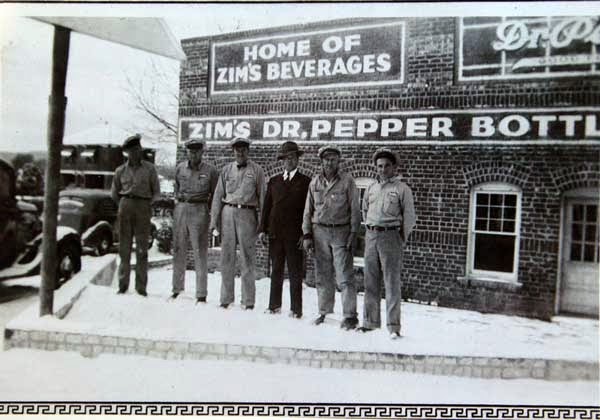
Zim’s brick service station – restaurant – Dr. Pepper bottling plant stretched along the west side of the two-lane highway, just south of the first Palo Pinto Creek bridge (past the Necessity cutoff). The mid-October morning I visited, 42 degree silence greeted my arrival. I crawled out and walked across brick pavers to survey the abandoned brick gas station, the rotting wooden overhangs held aloft by iron tie-rods. Twenty Model A’s or Model T’s could’ve packed this station, back in the day.

My Model A now full of gas, I might have eased down the hill to the Y intersection at the filling station’s left. Travelers veered left to the Dr. Pepper bottling plant or right to the tourist court. I opened the gate to the right (with permission). Walking beneath towering pecan trees, one quickly realizes there’s more here than meets the eye. The one story “filling station” visible from Highway 16 conceals a two story labyrinth, housing a gas station (four pumps), restaurant, bar, cavernous machine shop, bank, office, kitchen and more.
Back then, a muffled clattering vibration sound would have come from the south. Across the courtyard a hulking brick warehouse that once housed the Dr. Pepper (and Coca Cola) bottling plant stares back, once supplying soft drinks to this part of the state. A “Zim’s Quality Beverages” billboard painted on its side invited passersby to pull off the highway. West from there, a five bay Dr. Pepper delivery truck garage connects. Shooting north, five fallen-in tourist court motel room shells sit abandoned, the forerunner to the modern motel.

“Kids need to be kept busy,” Zim might have told me, showing me around. There was a small gold fish pond in the days before color TV. Families could also venture south to Zim’s swimming hole in Palo Pinto Creek, just below the Watson House (now Edwards Funeral Home). It was shady and had a rope swing. There’s a story about a handicapped boy on crutches looking down at this swimming hole from the Watson House. The embankment caved in, the boy fell in the creek and drowned.
The first thing you notice about Zim’s buildings is the handsome brick work completed by Zim’s father-in-law, Pete (“Piotr) Wasieleski. When Thurber’s mines began to wind down around 1921, Pete began working for Zim. Atop gentle wall arches facing the highway, three small round brick parapets crown each capital (think a rook in chess), their symbolism lost to time. The tumbled burgundy bricks lend the building a warm glow in morning sunlight. Ornate arched brick drains and soldiered brick accents above windows reveal artistry uncommon today.

 “This land looks awfully low,” I might have suggested to Zim. He would have smiled. Pointing back toward the main highway building, you come to understand that Zim created this place to “fit”. The Bankhead’s roadbed soars fifteen feet above the bottomland you’re standing on. Zim snuggled his two story station against that roadbed. Its second floor fronts the road (was high enough). The bottom floor faces the other direction, sitting comfortably on the ground. Elaborate stone-lined ditches channel rain water to the creek. One rock-lined channel travels under the entire length of the main complex. Fit your building to the land, not the land to your building. Think Frank Lloyd Wright.
Marche (MARCH-EE) “Zim” Zimicki was born in 1897 in Pennsylvania’s rough-and-tumble coal fields. His family (originally Zamitzski) worked in Thurber’s mines by 1900, moving to Lyra’s mines by 1910 (between Strawn and Mingus). Being the only boy (three sisters), Zim and dad Pete worked in the mine and farmed (graffiti on a nearby water well records “Marche 1917”). Zim may have started mining as young as 13.

When Zim returned from WWI, capitalism’s wheel began to spin more rapidly in this creek bottom. Zim took a job nobody wanted, tearing down the old Stephens County Courthouse in Breckenridge in 30 days. One wonders if some of the pressed tin ceilings above the gas pumps come from that facility. Streamlining his family name for “only in America success”, Zamitzski became Zimicki.
Father and son pooled their income, giving them the stroke needed to buy these twenty acres along the northern branch of Palo Pinto Creek. Other nearby land holdings were added at bargain-basement prices during the Great Depression.
Zim must’ve absorbed the Thurber “vertical integration” that Colonel Hunter and W. K. Gordon infused into Texas and Pacific Coal operations, offering coal miners not only a place to work, but providing for their human needs with company stores, bars, church buildings, even a cemetery. Zim dreamed of satisfying a similar menu of his visiting Bankhead Highway guests’ needs on their journey toward the Pacific.
            This complex was and is a work in progress. Begun in the 1920s, major construction took about a year to complete. Zim built the gas station, then the restaurant, ice house, bottling plant, and travel courts. Though run by family and staff, Zim could be seen everywhere, doing everything. Zim dressed plainly, not being a “behind the scenes pencil pusher.” Before we arrived, he likely just crawled out from under a truck, rebuilding its transmission.
Zim also mastered the load-bearing engineering he observed in the overhead wooden timbers holding up the uncertain ceilings inside Thurber’s deep coal mines. Zim’s ground floor machine shop’s ceiling reveals strong concrete beams atop solid columns carrying the weight of the entire suspended second floor.
Zim built his own power plant to supply electricity to the complex using a large diesel motor. To start the diesel engine, one had to light a wick (in place of a spark plug) and stick it in a hole (filled with gas) while cranking the engine. This required a man of deep faith (or great speed).

Zim owned the Dr. Pepper and Coca Cola franchises simultaneously for awhile. Coke asked Zim to tie into Strawn’s city water and stop using his well water (still in operation). Zim told them to go to hell (diplomacy not among his virtues). Today’s Strawn Museum (open 11 – 4, Thursday - Saturday) houses several versions of Zim’s Quality Beverages heavy, opaque Dr. Pepper and Coca Cola bottles, listing Breckenridge, Strawn and Cisco as his territory. Zim might’ve also leaned toward Dr. Pepper, as they also offered Crème Soda, Lemon, Lime and Strawberry drinks in their lineup.
Zim’s ground floor machine shop was always turning out clever gadgets – inventions, cattle guards, truck repairs, and gates. Old truck frames converted into work benches still do their duty. Discarded tin Coca-Cola signs hang from the black-dark ceiling awaiting their next assignment. Zim received a patent for delivery truck racks that allowed drink cases to slide forward on rollers when other cases were removed. He built a revolving cross for Strawn’s St. John’s Catholic Church bell tower, though this was never installed.
            Zim had a bar on the second floor. Accessed from the highway’s front door or up a winding stairway from the bocci ball courts below, one delights in the stout wooden columns that frame large mirrors behind the bar. There’s a kitchen to one side, a wood-planked dining room/dance hall to the north. “It happened right here,” I felt the room’s shadows whispering, though what happened there, I may never know.
The new owner, a kind man, lifted one of the barstool seats from its pedestal and turned it over. The seats were made from truck hubs, fitted onto cams atop their poles below, just like a delivery truck’s axle. I know Zim is smiling in heaven as I reveal his ingenuity and thrift. The bar counter’s base features corners of ridged glass blocks. The juke box surely played country swing dance tunes as working class couples circled the dance floor, gold-trimmed ceiling fans click-clocking lazy circles into the pre-air conditioning summertime air.

Between the restaurant and the backyard tourist court sat picnic tables, barbeque pits and bocci ball courts under shade trees providing travelers a much needed overnight oasis. The southern room of the filling station still boasts a full-sized bank safe built into the wall. There’s a story that Zim had a little bank for awhile, though sheltering Zim’s steady cash flow seems as likely (or perhaps a lack of trust in post-Depression banks).
Under the highway bridge outside one observes graffiti, colorfully modern and vintage. One scribe writes “Wiley Wells…From Buffalo, N.Y…going to God’s country. March 29, 1929.” I hope Wiley made it. Seven months later, Mr. Wells’ young nation plunged headlong beneath the waves of its first Great Depression.
 “Zim was tight-fisted, inventive, and versatile,” remembers nephew Leo Bielinski, “and quite an accordion player.” In the late 1940s, Edward Dumith was building a home in Mingus. Being Zim’s friend, Dumith hoped to buy some of the old (but solid) lumber salvaged from the Stephens County Courthouse at a “buddy” price. No such luck. Dumith could’ve bought lumber from the lumber yard at the same price. Zim used old Magnolia Beer signs to flash the bottling plant’s roof. He used discarded Coca-Cola signs to form the restaurant’s stout structural concrete foundations.
            One neighbor child remembers an army of people constructing Zim’s. As Thurber, Mineral City and other area coal mines were winding down, cheap labor was plentiful. These ex-coal miners (doing the work of three men today) did the heavy lifting, with Zim leading the way. In addition to Wasieleski, Zim’s brother-in-law Big Joe Daskevich helped construct the buildings, later rising to become bottling supervisor. Zim’s dad Pete (then about 55) was also an old miner who could handle hard work.
Family helped Zim achieve his dreams. Zim’s second generation immigrant imagination helped provide for his family and employees during wrenching economic times. At family gatherings Zim played his accordion. Wife Stella kept the books. When Zim and Stella married, they built a small two-bedroom wood home just south of the bottling works. With all of their wealth, they continued to live there until 1960, when they built the still-standing two story brick home just west of the original house.
            Zim wasn’t famous for paying high wages. When he bought ranchland around Strawn in 1938, Frank Bielinski and Tut Daskevich were paid $1.50 a day digging post holes by hand, ten hours a day. Of course, like today, any job was a blessing. When Zim’s son (Marche Pete) asked his dad to help pay for his senior year at Texas A & M vet school, Big Zim said, “Gosh, Marche, this school is costing too much. It might be cheaper if I just bought the damn school myself.”
            When the highway connecting Weatherford to Ranger was finally completed in the 1930s, it effectively killed Zim’s roadside business. He went into ranching, never missing a beat.
I was tipped to look for a hidden compartment built beneath the highway or bridge, to conceal beer or moonshine. I found no evidence of that. Zim didn’t produce moonshine, both because of his upright wife Stella and because it would’ve exposed his prosperous business to seizure by federal revenuers. Hiding his own hootch from his eagle-eyed wife Stella, however, keeping her from knowing he was “nipping at the bottle” was certainly a possibility.
Zim did own a honky tonk to the north in Metcalf Gap after Prohibition was repealed. This was a rough place, frequented by thirsty cedar hackers (talk about hard work). But Zim was all about making money. When beer cans came along, most drinkers used a “key” to open them. Zim invented a foot-operated can opener for his bartenders, to speed his liquid commerce along.
Shortly before Zim’s death, he was asked to speak to the Strawn Lion’s Club. He told this story: “It was a full moonlit night, freezing cold. The birds had nothing to eat and they were miserable. But an old bull in the corral had just let a nice steaming cow pie. A mockingbird flew down and gobbled this up. Now he was warm, and full, and contented, so he began to loudly sing. The disturbed rancher who was trying to fall asleep grabbed his 12-gauge and blew the bird away. The moral of this story: When you’re full of BS, keep your mouth shut.”
            Zim finally sold the Dr. Pepper bottling operation to M. L. King in 1937, who moved it to Ranger. One also finds Zim’s Heileman Brewing distributorship flyers (with offices in Strawn, San Angelo and Big Spring) among historic Zim literature. The multiple offerings of all Zim’s enterprises may never be known.
            Zim would have been pleased, I think, that another visitor to his American dream got what he came for. Several that lived in the Strawn area and many that traveled through it came to know the man Zim Zimicki by his works. I add myself to that list. The day warmed as I climbed in my car and drove away.