The Texas Tabernacle contains writings and photos about the people and history of the Palo Pinto River and the Leon River Country, Eastland, Palo Pinto and Stephens County, maybe old friends and detours that will likely occur along the way. I like to look for the old things...events that happened, or maybe should have. Listen to what they have to say.
Everything Matters
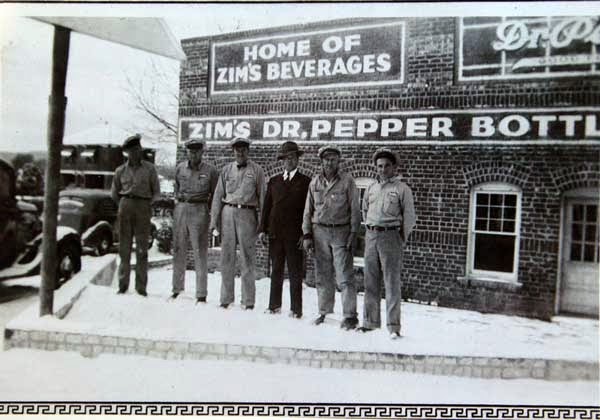
Zim's Bottling of Strawn
Showing posts with label Weatherford. Show all posts
Monday, January 5, 2015
Friday, April 18, 2014
The Will Jacobs Story
Will Jacobs’ Fiery Piano Life
Stokes Danger into a Musical Inferno
By Jeff Clark
Something’s gone horribly wrong.
Piano player Will Jacobs fought a
pitched 40-year battle with his demons inside ragged honky tonks stretching from
Austin to Oklahoma City . Today he
plays rest homes, when they’ll let him.
For free.
Will’s just been approached by a
national agent wanting to set up a tour, he says. He won’t open for another
artist, he tells me. We sit inside his two room rented house.
Will can play nine hours and never
repeat a song. But nobody’s calling. “That’s got to get inside you a little
bit,” he tells me. “Someone sees you with a beer bottle or you cuss out an
audience and it haunts you the rest of your life.” Today he wanders the streets
of Weatherford, when he’s not laying brick or stone.
I visited
Will’s place a week ago. We talk a while, then he picks up his dead brother’s
blue guitar to play. The musician’s 59-year-old stare is captivating.
He doesn’t look away.
When Will
strums the acoustic guitar, he digs deeply into lyrics from his life’s front
row anguish. Will considers himself a Throw Away. His words. He tends to bond
with other Throw Aways of society, he confides. “We can be happy, you know.”
This man’s been married three
times, but confesses another lover always came first. “When I saw that big black
man unload that piano when I was a kid, when I saw those black and white piano keys
rolling down the ramp into my house, I knew the piano would be the love of my
life.”
Will’s lifelong musical tryst has
brought him insanity, he volunteers. “I’ve lost my mind over music, then music’s
brought me back. Music has been more a part of my life than the women were.” The
Rules Don’t Apply Here nightclub life seemed ready made for this man to exercise
some demons.
You can see
Will Jacobs walking two or three miles a day around Weatherford, if you know
where to look. He’s survived 10 years without a car. “The only thing I like as
much as playing the piano is walking. Sometimes it’s meeting someone. It gets tough
about the time the bills come due, but I’m living life the way I want to.”
He’s not
about Things, he wants me to know.
The man leans his body into and out
of our conversation, much as he does at the keyboard. He’s good in his own skin,
the heck with what anybody else thinks.
Jacobs has seen everything while
looking across the top of nightclub pianos – old couples dancing, still in love,
wicked bar room fights, anguished tears, rowdy laughter hiding sticky stinging beer-stroked
pain.
Playing to a honky-tonk crowd can
be like snake charming. The greats did this, he tells me – Hank Williams, Sr.,
as one example. “He’d look into the eyes of his audience – his music could make
that audience do whatever he wanted.”
“When I was a kid, people thought
the honky tonk music I played was of the devil.” Jacobs disagrees. “God isn’t
so strict he has to only hear Jesus songs. When you hear Hank Williams sing
“I’m so lonesome I could cry” that’s a human experience –that’s holy.”
Jacobs wakes up each morning and
asks, “Okay Lord, what are we going to do today?” His walks are spiritual
releases of stress, a way to exercise. “I meet 100 people a year walking. What
if one of them becomes a friend?”
Personal struggles
drive his art. “I’m on the other side of hurt now. I’ve struggled with alcohol
all my life. But, now I’m trying to keep my mistakes down to a minimum. We have
to be real with ourselves. Who we are.”
Bill Jacobs taught his son Will the
Missouri Waltz and the Boogie Woogie when he was six, growing up in Weatherford.
Bill played the accordion, the guitar, the piano and was song leader at York
Avenue Baptist for a time.
Three other men impacted Jacobs’
musical education. “Floyd Cramer taught me technique and simplicity. Ray
Charles, that I can arrange my own songs. And Jerry Lee Lewis showed me when I
was 11 – you can play the same song 100 different ways.”
You can play the same song 100
different ways.
Jacobs has played Toulouse in Austin , the Diamond Horseshoe in Puerto Rico , The Stumble Inn in Oakhill, the Cedar Chopper’s
Lounge in Cedar Park , Leon ’s Country Store in Rockne,
Weatherford’s Peach Festival and Christmas on the Square, Kickers Palace
in Poteet and Austin ’s
fabled Broken Spoke. He’s performed with David Wills (“I Need a Drink, Here’s
$20”), Johnny Lyons at the Flores Country Store outside San Antonio and Kenny Dale, among others.
“I played about 70 nightclubs. Some
of them I played once and a lot of them I played many times.”
Will hasn’t had a paying gig since
August 2010.
Truly creative people can be misunderstood,
he tells me. We talk of John Lennon and Edgar Allen Poe. “People that run the
world are clever, but not wise. They’ve got their own little boxes they never
get out of.” I can tell looking around Jacobs’ living room he can’t even see
his box in the rearview mirror anymore. Will’s house is a working museum filled
with achingly honest vinyl records and Polaroids from his attempts up music’s
high summit.
A compliment, I assure you.
“A lot of times when you’re not
born rich, you have low self-esteem, a chip on your shoulder. You normally
don’t ever get over it. There’s such thing as having self respect, however.
It’s not ego. You look people in the eye. How are you going to correct them, if
you don’t assert yourself? The problem in America is that everyone’s hiding
behind this politically-correct stuff. It’s like fake wrestling. The more I
keep my ego in check, the better I do.”
His eyes never leave mine, main
lining his uncensored thoughts into words the rest of us are then able to hear.
Musicians are struggling these days,
he confesses. “There’s a quarter of the world who want to hear blues, gospel
and what I do. But they’re not going out anymore. They’re jaded. The rest of
the world likes garbage.”
Jacobs has starred in bar fights,
been spit on, thrown out, and had a front row seat to 357 Magnum gunfire. The
stink of spilled Lone Star and the sour perfume of too-many-dance partners
slink along the underbelly of his venues.
Will sometimes lays brick or stone
to pay the bills. “My daddy made about $125 a week, so I guess we were poor. He
was a genius in electronics.”
The day I visited, we ran up the
street to Weatherford’s Keeneland Rest Home. They have a piano. They have an
audience. Jacobs might’ve said hello as we burst through the front door, but if
he did, I missed it. I do remember that he stepped around wheelchairs and
gossip and strode to the piano standing against the wall like he was cornering
a long lost lover. He began playing its keys fast and hard, throwing each song
to the ground.
No questions.
Just sing.
“The reason I play at rest homes is
important,” he tells me. “They’re dying in there. They deserve better.”
Women in wheelchairs rolled up as
Jacobs pushed through the first 1950s blue-suede hit. A former stuntman from
Gunsmoke walked up, introduced himself. One of Jacobs’ walking-around-Weatherford
discoveries.
People start swaying, patting their
hands in time, his loud playing fingers dancing up and down the keyboard. Will
plays songs his audience remembers, doesn’t start out with gospel music, not caring
if they think he knows God or not.
He does.
Jacobs makes intense eye contact
with his audience – a hint of danger or purity, I can’t decide which.
Is too much purity the root of
danger itself?
His finger-fueled riffs make it
hard to look away. I was impressed with his talent, as his textured voice
hot-boxed lyrics out into the audience. The Artist Will Jacobs came alive to
the touch of his lifelong love, the piano, singing for him beneath his electrified
fingertips.
His lover likes it rough.
“One night I sang this song I wrote.
I was sitting at the Cameron Road Inn in Austin .
Doing songs, having a good time. There’s this guy trying to pick a fight with me
because his wife’s over there swinging her hips for my benefit, so I play this
song. I was drinking beer and Weller’s Whiskey. I was cocky. The audience froze
because the song was so honest:
I looked for an answer, my whole life through,
just thinking that someone would appear in the room,
after 89 questions and 3,000 lies,
I woke up one morning and I opened my eyes.
They’re too scared to live, and they’re too scared to die.
And they shake their fists up, and they cuss at the sky.
They’ll drive to their churches, and they’ll drive to their bars,
because they’re running from the truth, in prestigious cars.
Don’t trust books, because they’re usually lies.
Just learn what you see, with your storybook eyes…
I want to like Will Jacobs. I respect
his danger, admire his courage. But no one’s calling him for gigs. Spring turns
into summer. His musical life could still go either way.
He knows it.
Will seems at peace with that
uncertainty, for reasons I can’t quite understand. “I know there’s a God. If
you help people out, that keeps it under control.”
Will’s house sits on the road I
take to visit my parents. It’s Saturday night. His lights are on. I have to
believe he’s home. I have to believe, for a long list of logical reasons,
tonight’s honky-tonks are missing out. Or maybe just taking a break, awaiting
Will’s second act.
“I need to connect to an audience
pretty soon,” he tells me.
Is too much purity the root of
danger itself?
Thursday, February 13, 2014
Is History history?
Is Parker County
History History?
By Jeff Clark
There was a
time when Parker County history was chased after like a
long lost love. Log cabins could hide along forgotten creeks, knowing someone
like Mary Kemp would be along shortly, would return their story back into the pages
of this county’s recorded history. Doing local history has become like
television – we can give it our time, but first it must entertain us.
The story of Parker County
was largely written by “hunter/gatherer” historians like Evlyn Broumley, Fred
Cotton, Mary Kemp, Dodie Sullivan ,
Leon Tanner and
others. These folks were not formally trained. Most were born here, all were
consumed with the desire that their hometown’s legacy be remembered, preserved
and celebrated.
These folks slaved away in courthouse
basements or chopping brush away from lost cemetery headstones by themselves or
in small unorganized groups for decades. No grants, no employees, no hoopla.
Today a robust menu of local groups
is still doing important work, each holding a different part of the elephant:
the Parker County Historical Commission, the Weatherford Historic Preservation
Commission, the East Parker County Genealogy and Historical Society, the Parker
County Texas History and Heritage Inc., Parker County Heritage Society, the
Parker County Archeological Society and more. There are also individuals like Debbie
Liles (the Parker County Oral History Project) making significant contributions.
Still, I sense something’s changing.
The Parker County Genealogical
Society disbanded after 41 years. Its 37 charter members have “gotten old or
passed away,” charter member Evlyn Broumley told me. The internet has also made
the in depth research these trailblazers pursued a rarity, even among scholars.
There’s still a lot of history out
there to discover and document, almost all I spoke with agreed. Lowell “Dodie” Sullivan,
president of the Parker County Abandoned Cemetery Association tells me three
“lost” cemeteries were restored just since August.
Watching bulldozers and dump trucks
pave What’s Next across Weatherford’s landscape, I begin to wonder if anyone cares.
Broumley used
to get five to 10 research queries a week. “You don’t get them anymore.” She
fills her weekly column with interesting snippets from old Weatherford newspapers.
This should’ve been a clue.
People have
become readers, not writers.
The internet is one factor. “You still
have to get offline sources,” she told me. “You can’t believe everything online,
in a book or what Aunt Mary said until you can prove it.”
People settle for “good enough” research
in this bulleted age of blogs and sound bites. The “why things happen”
questions sometimes fall by the wayside.
Broumley said she still gets
questions from people wanting to know about the area, “but you can’t really
separate people out of history – they make it.” She’s come home from “hands on”
research and preservation scratched by briars, bitten by a dog and having walked
up on a rattlesnake in the woods. “Did you know you can jump flatfooted
straight up from the ground?”
I asked Broumley who her
replacement would be. She mentioned a granddaughter in college who will be 65
four decades from now. I hear bulldozers rumbling in the background of my
concern.
Fearfully, I begin searching for
the next Evlyn Broumley, the next Mary Kemp.
I started looking
inside the 18-member Parker County Abandoned Cemetery Association (ACA). They
maintain 64 cemeteries within 30 square miles.
Word of mouth delivers most
volunteers. “You get to a certain point in your life,” President Dodie Sullivan
says, “when volunteering fits your life. You’ve retired, the kids are grown. A
lot of people will volunteer if you ask them at the right time.” The ACA has
also received help from the county commissioners, volunteers and landowners in
the past.
Lost graveyards are often discovered
by new landowners clearing brush. A man called them about the abandoned Clower Cemetery
near Whitt. The ACA got to work. Census records were searched to match each
headstone’s identity. Brush and high grass was trimmed back. Dodie feels like
he knows the people in each cemetery after he does all that research. It
connects him to the cemetery’s future care.
Few ACA members are younger than
65. The Parker County Committee on Aging reports there are over 13,000 senior
citizens in this area.
Mary Kemp worries about the future
of “doing history” in Parker
County . “Most people
don’t remember the Great Depression, don’t remember WWII,” she said. I asked
her where her passion for history came from.
Kemp’s
mother took her to visit their family’s Parker County
cemeteries when she was a little girl. “She told me their stories, who those
people were.” Families would meet at Spring
Creek Cemetery
to take care of their own plots. “If another family’s plot was uncared for,
everyone just pitched in.”
Children
worked beside parents, heard their stories, built community with the folks that
came before.
Mary has written five books, edited
or co-edited the two Parker County History books, had a hand in 17 state historical
markers and helped restore numerous historic buildings and cemeteries. “I
couldn’t have done what I did without family, friends and volunteers helping
all along the way.”
Those who know Mary, however, know
she’s a self-appointed committee of one – her own parade or the leader of small
parades when she finds something that needs saved. Still, Mary’s fabled
sunbonnet, boots, gloves, and grubbing hoe haven’t left her closet in a while.
Mary’s “Shaw-Kemp Open House” draws
4,000 visitors each spring to see bluebonnets blooming among an 1856 log cabin,
a 1918 homestead and many other historic structures she’s preserved south of
town.
Mary went hard core into her
historical pursuits when she was in her mid-50s. “Who’s the next Mary Kemp?” I
ask.
Mary smiles. “I love all my
grandkids, all my great grandkids equally.” They call her “Great Ma.” Mary’s 11-year-old
great granddaughter Taylor Todd Kemp has come to Mary when working on school
projects, has her same love of dolls (Mary’s collection numbered in the
thousands), and is asking the right questions a young Mary Kemp might ask.
If Taylor cranks up her research in her
mid-fifties like Great Ma did, the Mary Kemp machine will lay silent for 40
years.
That’s a long time for this county to
wait.
The Doss Heritage and Culture Center opened four and a half years ago,
the 25 year culmination of work by a small group of local leaders called Civic
Development. Many don’t realize the beautiful stone building at East Park
and Texas Drive
houses a museum. The Doss often adds the new tagline “A Texas History Museum”
to their promotions.
Exhibit Coordinator C.B. Williams
shares that a recent seminar for museums she attended said that the typical
format museums use to showcase their history archives is changing. Museums must
compete with places like Six Flags for the attention of potential visitors.
Looking to the east, I notice that the
Fort Worth Museum of Science and History changed their approach. Quiet “nailed
to the wall” static displays have been replaced by lively “hands on” exhibits,
videos, and interactive games.
The Doss has learned that their
opportunities for educating youth will grow if current traditional exhibits are
enhanced by interactive displays, video games, and turning the Mary Martin
Collection into a more dynamic “Broadway Experience”, as one example.
The Doss already boasts interaction
with area youth through school programs, Doss Wranglers weekend classes and
“Gone to Texas ”
and “American Indian” summer camps for kids.
“We have so much to compete with
for kids’ entertainment,” Williams says. “We’re going to be the Kimbell
someday, only about history.” The Doss would be a destination.
The Doss sits on seven acres leased
from Weatherford College for 99 years. It hopes to fill
these seven acres with six log cabins now in private hands. The Doss just
started tapping into Weatherford
College as a resource,
using students to design video games for future exhibits or using archeology
students to research Parker
County ’s prehistoric history.
The Weatherford Public Library
boasts a great history/genealogy collection – old maps, newspapers, files on
families and old groups. And let’s face it, newspapers, magazines, websites,
blogs – surely this flood of information will positively impact future
researchers.
Mary Kemp
is still always on call, even with her health challenges. Evlyn Broumley still
writes, still answers questions that trickle in.
Broumley
received a request for information last week. “There’s no way I can lift those
big deed books anymore.” Mary tells me she turned over many of her cemetery
records to the ACA last year.
“You have
to encourage people to become active,” Broumley told me, “as we become
inactive.”
The Good
Old Days often weren’t. A story like this written 20 or 80 years ago would’ve
revealed a haphazard approach to the gathering of county history. People like
Mary, Evlyn and their deceased forebears were out on a mission and worried
little about public image, Roberts Rules of Order or strategic plans.
Harder to document would’ve been
the little girls and boys hearing their family’s stories, visiting ancestral
hallowed places, taking within their own heart stories of where they came from,
of who their bold heritage would allow them to be in their own lives.
Look around Weatherford. The days
of story-telling old men drinking coffee together are coming to an end.
Children are rarely pulled away from their computer keyboards and handed a grub
hoe to tend grandma’s grave. What’s out in the woods will have to wait, will have
to hope the bulldozers can be distracted until the next Mary Kemp or Evlyn
Broumley make their entrance onto Parker County’s historic stage.
Plowshares Into Keyboards,
Quick Hits of History for Next Generation
People often confide “I wished I’d
paid more attention to grandma’s stories about the old times when I was growing
up.” Today’s college student or history researcher will likely hit Google or
rootsweb.com websites, before thinking to ask grandma (who lives in another
state) or God-forbid opening a library book.
I became curious about the future
of “doing history” in Parker
County . Through the
years, our first hand oral history changed to second hand written history and
now heads toward filtered, anonymous online history. The computer becomes the storyteller,
instead of whoever generated the original “content”.
We can’t ask a black man in
Weatherford what it felt like to be discriminated against, unless we go knock
on his door.
Indiana Jones didn’t use the
internet.
Early on, I suspected internet access
to websites like Ancestry.com was the culprit. That’s not the entire answer.
History is like football. It can be learned, played, or watched. Imagine
learning to play football by reading a website. The gathering of history is no
different.
Professor Brad Tibbitts teaches
history at Weatherford
College . “Students
entering college are being taught history in a very interactive way.” They are
exposed to computers and DVDs to receive information. This trend will increase
as time goes by, he believes.
College courses still offer
lectures, but students want content to be as interactive as possible. Many
textbooks have DVDs in the back. Companies selling learning materials realize
this and push the envelope, developing progressively more interactive means of
learning, moving away from lectures and original research. Searching for a
relevant book becomes passé.
Students learn with computers, video
games and online. They become “recipients” of information, not discoverers.
Most of what Tibbitts’ five and
ten-year-old grandsons requested for Christmas consisted of electronics. This
year’s high school graduating class will be the first Google Generation, being
born the same year the search engine came into being. These students believe
the answer will hit their screen, if they type in the correct question.
When Tibbitts was a kid he occupied
himself outside, his imagination or friends providing the chief search engines
of his entertainment. Now many kids remain inside watching hours of TV or
playing electronic games. Goofing around with your friends has become a schedule
of activities organized by adults.
No one knows the long term
implications. “Things don’t get melted in the melting pot like they once did,”
Tibbitts said. “People don’t get to talk to different types of people like they
once did.” Children “talk” through the filters of text message, email or
Facebook.
Even the use of the telephone is becoming
limited. Each semester Tibbitts explains to new students that telephoning or
dropping by his office will facilitate better interaction. Students are
resistant to using the phone, though it’s hard to text message the same subtlety
of 1950s race relations that one can see in person on the twisted face of an
80-year-old man who suffered it first hand.
We talk more AT each other using
electronics, not WITH each other like we did in the past. Public discussion is often lost in a tide of cynicism and
reproach.
“It’s important to set examples
that are worthy,” Tibbitts believes. “Look more at how we’re alike, not at how
we’re different. If we’re losing the ability to talk as people it’s dangerous
for this country,” he adds.
Tibbitts sees similarities between the
current tenor of public discourse and that shortly before the Civil War. It was
easy to see Northerners as Them, not taking the time to know or understand
their point of view.
Tibbitts has taught young people
for 44 years.
“I think it’s important that we be
mindful of who’s coming along behind us,” he said. The path we lay out will be
walked by our children and grandchildren.
We are being taught by machines, expelling
information input by people we may never know. Many accept the truth of what
pops up on their computer screens. The story and meaning of the nation and of Parker County
history become shallow and prone to misinterpretation when we become “watchers”
of the world instead of people actively digging into Parker County ’s
soil for its truth.
Donate Grandma’s Stuff
Where It Will Live Forever
“A lot of things get into the hands
of people who don’t care,” historian Evlyn Broumley says. Parker County
citizens have amassed rich personal collections of papers or artifacts over long
life times. “Things get lost,” she added. “Private collections become at risk
or disappear once their collector dies.”
Though these collections are viewed
as strictly private property by out-of-the-area heirs, the harmful impact to
the county’s history when these treasures are lost or destroyed is hard to
overestimate. There are core historians in this county who are unsure where
they’ll leave their valuable collections.
As Weatherford continues to grow,
we don’t know all our neighbors. We don’t know which door to knock on searching
for this county’s Holy Grail.
The Doss Heritage and Culture
Center’s C. B. Williams reports that a lady recently walked through their front
doors with one of Oliver Loving’s quilts. None of her kids wanted it. What if
that kind donor had passed away before her important gift?
Broumley encourages heirs to donate
at least a copy of important papers somewhere safe. She suggests a local
collection, but advises that one ask important questions: do you want these
things, will you preserve them, and what happens if you close or change your
mission?
Broumley places duplicates of her
work in multiple places. Just because an event is recorded in a book, doesn’t
mean it happened exactly that way. “You’re taking one person’s report, what he
saw and remembered,” she says.
When grandma dies, you can toss her
collection in the trash, donate it to a college or university, attempt to maintain
the collection yourself or find a local archival facility like the Doss or the
Weatherford Library.
The Weatherford Library will copy
family bibles and place them in the files (there’s nine filing cabs in the
Weatherford Library now). The Doss Heritage and Culture Center
will accept items if they comply with their mission statement (www.dosscenter.org).
In a nutshell, if grandma’s history happened in Parker County ,
it has a pretty good shot at the Doss. If not, it could still be used in education.
Researching a recent story, I was
told that the late educator Raymond Curtis maintained a lush collection
regarding Weatherford schools. Though I was given many clues, I could never locate
this treasure trove. I completed my story sensing one of Curtis’ boxes might’ve
held an underreported chapter in this city’s history.
Many artifacts are offered to the
Doss. Their Collection Committee reviews these donations, which can be made as true
donations, conditional donations or loans for an agreed-upon period of time.
“We learned about a 91-year-old
lady from her husband,” Williams told me. “His wife lives in a nursing home.
When she was born she slept in this wonderful pioneer cradle, which she donated.”
He asked if the cradle was being exhibited. Williams told him that she wished
his wife could come see the museum to see where she donated her wonderful
treasure. Parker County Transportation brought her to the
Doss. Her wheelchair was rolled in and she saw her donations distributed among the
exhibits. She cried with happiness and shared many old stories.
Doss Archive/Collections
Coordinator Delissa Slimp wants to make sure, however, that people know that
donating is no guarantee that materials will always be on exhibit, due to space
limitations.
There are other great archival
facilities like Texas Tech’s Southwest Collection in Lubbock, UTA’s Special
Collections and several other Texas
colleges and universities. These can offer unparalleled safety and integrity to
historical collections, but they lie outside the county.
The Doss has catalogued storage facilities
on its ground floor, as well as climate-controlled storage offsite. Like most
history museums, they utilize the Past Perfect software to catalog their
collection for researchers’ use. The Doss has already assisted college student
research, using their four and a half-year-old collection. The Doss is a
501(c)3 entity and is incorporated. The assets (collection) of the organization
would be turned over to another non-profit organization or as directed by the
board to an organization should the structure of the Doss ever change.
Ideally, historians should visit
these facilities themselves. Ask the important questions. Then let their years
of hard work go forward to help future researchers piece together Parker County ’s
important legacy.
Special
thanks to Joann Barnhart, Evlyn Broumley, Harold Lawrence, Wayne Lee, Mary
Kemp, Betsy Pedigo, Linda Pelon, Delissa Slimp, Lowell “Dodie” Sullivan , Leon
Tanner, Brad Tibbits, C. B. Williams, Rae Wooten and the Weatherford Public
Library.
Saturday, December 14, 2013
Weatherford, Texas Black School
Black Mount Pleasant School Forges
Two Communities Into One
Race riots may be coming to Weatherford. That was the talk around town. Images of angry police dogs, fire hoses and bloodied protestors across the Deep South paraded across Parker County TV sets in the early 1960s. Some feared a repeat performance here.
When Weatherford schools opened that first 1963 day of integration, all was quiet. The reasons are both simple, and complex.
Our mystery begins in church. Two years after the Civil War ended, blacks organized the Prince Memorial Christian Methodist Episcopal Church on Oak Street. This oldest “still in business” church in Weatherford was named after the Rev. A. Bartlett “Bart” Prince, its first elder (as is Prince Street, near the first black public school). The church’s building went up in 1871, and was modified in 1912.
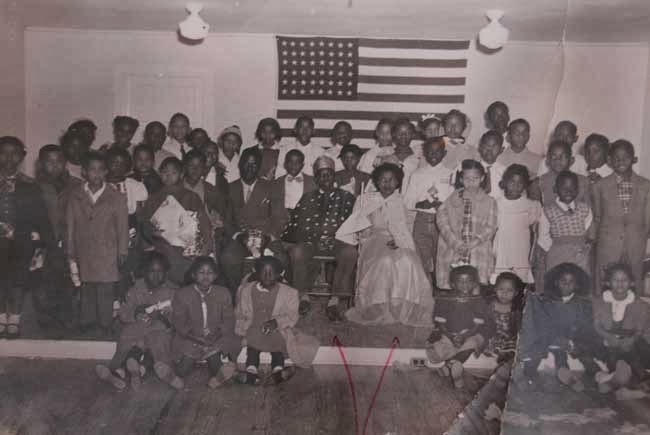
The “CME” sign in front meant “Colored Methodist Episcopal” until the 1960s, when it changed to Christian Methodist Church. It’s believed to be the second oldest CME church in the nation. There’s no Texas Historical Marker here. Within this pioneer church’s walls, black students received their first education, until the county built them a schoolhouse. Smythe’s 1877 “Historical Sketch of Parker County” lists thirty-seven county schools that year, each tied to a geographic “community”, save one: School No. 33 – The Weatherford Colored School.
Seymour Simpkins taught thirty-nine “colored” students. Prince Memorial pillars Willis Pickard, Rev. Henry Johnson and Rev. Prince served as trustees. The “Colored School” gets mentioned in the newspaper off and on down through the years. In 1887, land just south of West Oak and west of Prince was purchased for $200, its schoolhouse built in 1917.
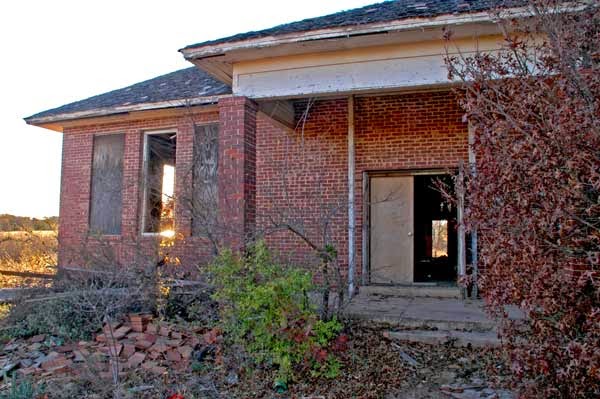
A brick school house replaced that structure in 1927. Today that forgotten brick schoolhouse stands proudly among the weeds. The September 8, 1933 Weatherford Democrat lists five ward schools that year, plus the “Colored School”. Tillie Woods was principal and Ella Varnel was the teacher.
The “Colored School” taught Cub Young, who pitched against Satchell Paige in the Negro Baseball League. Weatherford’s Negro League team played where Weatherford High School is now.
Within this pioneer
church’s walls, black students received their first education, until the county
built them a schoolhouse. Smythe’s 1877 “Historical Sketch of Parker County” lists
thirty-seven county schools that year, each tied to a geographic “community”,
save one: School No. 33 – The Weatherford Colored School. Seymour Simpkins
taught thirty-nine “colored” students. Prince Memorial pillars Willis Pickard,
Rev. Henry Johnson and Rev. Prince served as trustees.
The “Colored School ” gets mentioned in the newspaper
off and on down through the years. In 1887, land just south of West Oak and
west of Prince was purchased for $200, its schoolhouse built in 1917. A brick
school house replaced that structure in 1927. Today that forgotten brick
schoolhouse stands proudly among the weeds.
The September 8, 19 33 Weatherford Democrat lists five ward
schools that year, plus the “Colored
School ”. Tillie Woods was
principal and Ella Varnel was the teacher. The “Colored School ”
taught Cub Young, who pitched against Satchell Paige in the Negro Baseball League.
Weatherford’s Negro League team played where Weatherford High School
is now.
Leonard Smith
entered first grade at Mount Pleasant
in 1939, three years after it was renamed the Mount Pleasant School .
The school’s two classrooms taught nine grades then.
Most black
students walked to Mount Pleasant
from four Weatherford neighborhoods – The Flat (First Monday Trade Day Grounds
area), The Hill (West Oak Street
area), Sand Town (near Akard & Sloan) and The
Neck (near Cherry
Park ).
Black and white
kids played baseball together, had rock fights, and cut up like children still
do. Raymond George and some of his white friends walked to school together in
the late 1940s. When they reached the Stanley School ,
the white boys went inside. Raymond kept walking.
“That’s just the
way it was,” he said.
Raymond remembers
there being about fifty students, though that number swelled when migratory
families came to town with the railroad or picking cotton. Raymond’s teachers (1946-1953)
included Ella Varnell, Lucille Rucker and Mrs. Roddy.
“Lucille Rucker
built the foundation beneath those black kids’ sense of respect,” Raymond said,
“respect for others and for themselves.” Not only was she a good teacher, she
was highly regarded by whites and blacks alike. Rucker made the boys play out
back and the girls play out front during recess. “She taught us to treat the
girls like ladies. Because of her, my generation of students stayed married,
kept one job our whole lives, and successfully retired from those same jobs.”
Still, when Mount Pleasant
closed, Mrs. Rucker was forced to do odd jobs to survive. “She wasn’t taken
care of,” he reflected sadly.
Wilson Hall was
added to the northwest edge of the Mount
Pleasant campus around 1944. Named after Superintendent
Leonard B. Wilson, it was a barracks-like building used for classes and
assemblies, with a stage on its west side.
Each large
classroom had wood floors and large windows along two walls. One can see
daylight looking up through fourteen foot ceilings to the sky. “These
classrooms were filled with little desks,” Charlie told me. “There were kids
everywhere.”
“Every morning all
the kids would walk out here, to the flag pole,” he said. “Say their Pledge of
Allegiance and sing a patriotic song.” The flag pole base remains. He showed me
where the swings were, the slide, the concrete front porch to Wilson Hall. “We
had more fun than you can shake a stick at.”
The schoolhouse road
entered from Prince Street ,
rising up the hill then circling the school. The old schoolhouse sits on
private property, contiguous to Love
Street Park
on its west.
This was a time of
separate white and black drinking fountains in our city. Blacks couldn’t enter
white restaurants (unless they worked there) or attend most theaters. Blacks
could buy Texas Theater tickets, as long as they sat in the balcony. Raymond
remembers walking through the Texas Café to the kitchen out back as a little
boy, wanting to spin the bar stools around. He couldn’t since the place was whites
only.
Weatherford had black
churches, a black tabernacle, and a two-story black Masonic Lodge on Fort Worth Highway, east
of the courthouse. There were few black businesses.
If black students
aspired to go to high school, they were on their own. Raymond and Leonard went
to Fort Worth ’s
I. M. Terrell High School. Most of these kids didn’t have bikes, much less cars
to make the thirty-one mile journey each way.
Raymond’s dad John
Lorenzo “J. L.” George stepped up between 1953 – 1963. He left his upholstery
shop twice a day to drive black students to Cowtown in his Ford station wagon at
his own expense. Local businessmen later chipped in to buy gas. When J. L’s car
got too crowded, a bus was finally supplied. J. L. spent five hours a day toting
school kids, losing this time at his store.
Mitchell Rucker
was another pillar of the black community here, born in 1899. “He was respected
by the white community,” Raymond told me, “but held at a distance.” In the white
community, Rucker was employed at the M & F Bank as a janitor. In the black
community, he was superintendent at Prince Memorial for over fifty years, taught
classes to Senior Citizens for the WPA in 1944, taught soldiers at Camp Wolters
and was a board member at Texas
College in Tyler for forty years.
Rucker was one of the main conduits between Weatherford’s white and black
communities.
“Pappa Ike”
Simmons was another black leader. He attended school at Prince Memorial, before
Mount Pleasant
was built. “Pappa Ike was more of a politician – he knew everybody, running
that mouth 100 miles an hour,” Charlie told me. Ike and brother “Uncle Charlie
Simmons” each raised families off shining shoes at the Palace or Texas theaters and at
barber shops.
Many prominent white
families had black nannies, butlers, and groundskeepers. There was a parallel
but unseen black society here, one from which trusted black men like Rucker,
Pappa Ike and J. L. George could communicate informally with the white
establishment.
Equally important,
several white leaders reached out to the black community – Jack Borden, Borden
Seaberry, the Cotton Family, and James and Dorothy Doss, among a few others. Respected
whites and blacks interacted, albeit at a distance. Though not treated equally
by any means, attacking one group would’ve meant attacking their own.
Mary Kemp
remembers when the integration meetings took place in the third floor study
hall of the old Weatherford
High School . “It was a
great time for all, very peaceful. I remember thinking, ‘This is a great
historical time.”
Charlie Simmons
was one of the first black students at Weatherford High School
in 1963. He did well, as hundreds of other black students had before, riding atop
the shoulders of Mount Pleasant ’s
teachers and black leaders. “It was a simple transition,” he said. “Nothing
happened.”
This would be
another “happily ever after” Weatherford story, save one omission. Unlike so
much of this great town’s heritage, the Mount Pleasant School
hasn’t been added to the roll call of hallowed historic touchstone sites in our
town.
Raymond George tried
to ignite a movement to get Mount
Pleasant a historical marker some years back, maybe
have the site turned into a museum or park. The Mount Pleasant School
site and several surrounding acres can be accessed from the city’s Love Street
Park and four city streets.
The old school’s roof stopped turning back the rain many years ago. This
historic place is not long for the world.
The Mount Pleasant School marks a chapter in Weatherford’s
history where two communities became one. Unlike much of the South, this town
pulled it off peacefully and with respect. As I put my camera back in its case,
I noticed graffiti on the wall of Miss Rucker’s last classroom:
“Hold
on to the ones you love,
cuz
you never know when you’ll lose them.”
Leonard Smith entered first grade at Mount Pleasant in 1939, three years after it was renamed the Mount Pleasant School. The school’s two classrooms taught nine grades then. Most black students walked to Mount Pleasant from four Weatherford neighborhoods – The Flat (First Monday Trade Day Grounds area), The Hill (West Oak Street area), Sand Town (near Akard & Sloan) and The Neck (near Cherry Park).
Black and white kids played baseball together, had rock fights, and cut up like children still do. Raymond George and some of his white friends walked to school together in the late 1940s. When they reached the Stanley School, the white boys went inside. Raymond kept walking. “That’s just the way it was,” he said.
Mount Pleasant was a two room school, several grades in each classroom. Florine Roddy taught in the southern room, when Raymond was a student. The northern classroom was Lucille Rucker’s. Outside sat two outhouses and a water well whose pipe led over a trough.
“One kid pumped while another drank,” Raymond told me. Raymond remembers there being about fifty students, though that number swelled when migratory families came to town with the railroad or picking cotton. Raymond’s teachers (1946-1953) included Ella Varnell, Lucille Rucker and Mrs. Roddy. “Lucille Rucker built the foundation beneath those black kids’ sense of respect,” Raymond said, “respect for others and for themselves.” Not only was she a good teacher, she was highly regarded by whites and blacks alike. Rucker made the boys play out back and the girls play out front during recess. “She taught us to treat the girls like ladies. Because of her, my generation of students stayed married, kept one job our whole lives, and successfully retired from those same jobs.”
Still, when Mount Pleasant closed, Mrs. Rucker was forced to do odd jobs to survive. “She wasn’t taken care of,” he reflected sadly.
Wilson Hall was added to the northwest edge of the Mount Pleasant campus around 1944. Named after Superintendent Leonard B. Wilson, it was a barracks-like building used for classes and assemblies, with a stage on its west side.
Mount Pleasant sits high atop the western skyline of Weatherford, looking down on the Courthouse to its east. Below its majestic perch, blight stares back from where working black families once raised families.
“Wood-burning stoves sat in the corners of each classroom,” Charlie Simmons told me, “replaced by gas heaters.” Flue holes still puncture the school’s two chimneys. Each large classroom had wood floors and large windows along two walls. One can see daylight looking up through fourteen foot ceilings to the sky.
“These classrooms were filled with little desks,” Charlie told me. “There were kids everywhere.” “Every morning all the kids would walk out here, to the flag pole,” he said. “Say their Pledge of Allegiance and sing a patriotic song.” The flag pole base remains. He showed me where the swings were, the slide, the concrete front porch to Wilson Hall. “We had more fun than you can shake a stick at.”
The schoolhouse road entered from Prince Street, rising up the hill then circling the school. The old schoolhouse sits on private property, contiguous to Love Street Park on its west. This was a time of separate white and black drinking fountains in our city. Blacks couldn’t enter white restaurants (unless they worked there) or attend most theaters. Blacks could buy Texas Theater tickets, as long as they sat in the balcony.
Raymond remembers walking through the Texas Café to the kitchen out back as a little boy, wanting to spin the bar stools around. He couldn’t since the place was whites only.
Weatherford had black churches, a black tabernacle, and a two-story black Masonic Lodge on Fort Worth Highway, east of the courthouse. There were few black businesses. If black students aspired to go to high school, they were on their own.
Raymond and Leonard went to Fort Worth’s I. M. Terrell High School. Most of these kids didn’t have bikes, much less cars to make the thirty-one mile journey each way. Raymond’s dad John Lorenzo “J. L.” George stepped up between 1953 – 1963. He left his upholstery shop twice a day to drive black students to Cowtown in his Ford station wagon at his own expense. Local businessmen later chipped in to buy gas.
When J. L’s car got too crowded, a bus was finally supplied. J. L. spent five hours a day toting school kids, losing this time at his store.
Mitchell Rucker was another pillar of the black community here, born in 1899. “He was respected by the white community,” Raymond told me, “but held at a distance.” In the white community, Rucker was employed at the M & F Bank as a janitor. In the black community, he was superintendent at Prince Memorial for over fifty years, taught classes to Senior Citizens for the WPA in 1944, taught soldiers at Camp Wolters and was a board member at Texas College in Tyler for forty years. Rucker was one of the main conduits between Weatherford’s white and black communities.
“Pappa Ike” Simmons was another black leader. He attended school at Prince Memorial, before Mount Pleasant was built. “Pappa Ike was more of a politician – he knew everybody, running that mouth 100 miles an hour,” Charlie told me. Ike and brother “Uncle Charlie Simmons” each raised families off shining shoes at the Palace or Texas theaters and at barber shops. Many prominent white families had black nannies, butlers, and groundskeepers.
There was a parallel but unseen black society here, one from which trusted black men like Rucker, Pappa Ike and J. L. George could communicate informally with the white establishment. Equally important, several white leaders reached out to the black community – Jack Borden, Borden Seaberry, the Cotton Family, and James and Dorothy Doss, among a few others. Respected whites and blacks interacted, albeit at a distance. Though not treated equally by any means, attacking one group would’ve meant attacking their own.
Mary Kemp remembers when the integration meetings took place in the third floor study hall of the old Weatherford High School. “It was a great time for all, very peaceful. I remember thinking, ‘This is a great historical time.”
Charlie Simmons was one of the first black students at Weatherford High School in 1963. He did well, as hundreds of other black students had before, riding atop the shoulders of Mount Pleasant’s teachers and black leaders. “It was a simple transition,” he said. “Nothing happened.”
This would be another “happily ever after” Weatherford story, save one omission. Unlike so much of this great town’s heritage, the Mount Pleasant School hasn’t been added to the roll call of hallowed historic touchstone sites in our town.
Raymond George tried to ignite a movement to get Mount Pleasant a historical marker some years back, maybe have the site turned into a museum or park. The Mount Pleasant School site and several surrounding acres can be accessed from the city’s Love Street Park and four city streets. The old school’s roof stopped turning back the rain many years ago. This historic place is not long for the world.
The Mount Pleasant School marks a chapter in Weatherford’s history where two communities became one. Unlike much of the South, this town pulled it off peacefully and with respect. As I put my camera back in its case, I noticed graffiti on the wall of Miss Rucker’s last classroom: “Hold on to the ones you love, cuz you never know when you’ll lose them.”
County Poor Farm, A Little Girl in the Woods
County Poor Farm
A Little Girl in the Woods
By Jeff Clark
A Little Girl in the Woods
By Jeff Clark
We may
lose everything.
There's a
depression heading our way. That's what the newspapers tell us. The economic
kind. Here in Weatherford. Nibbling around the edges of our little town -
taking its first taste.
Millions
of everywhere-but-here folks have lost their jobs already. Swept away by the
same tidal wave. Whose shadow we don't yet see. Most in this nation, in this
town, live three paychecks from the abyss. It will frost my britches, if my parents
were right.
A family
doesn't need nice cars, a big house. You don't OWN anything. You can't DO
anything. Why, your father and I made do with so much less. We didn't have to
worry about tomorrow. We didn't have to.
Then a
little girl calls out to me. "I survived," she whispers. "So
must you."
That
young girl's childhood, remembered by her through a prism of almost eighty
years, haunts me this day. She was my storyteller. I didn't see it at the time.
I visited her home expecting a Great Depression story of hardship and woe. That
cup was handed back to me, overflowing. But in the midst of today's woe, her
small farm girl's smiling stories keep bubbling to my surface. In the swirl of
terrible suffering, humiliation, of death, there had been joy. I pull out my
notes from our visit. I listen to her words.
Individuals and families deemed insolvent were "sentenced" to live there, many decades ago. When neither family nor neighbors would take them in. Many were old. Were infirm.
Pride
still governed our society back then. These folks weren't happy to be out
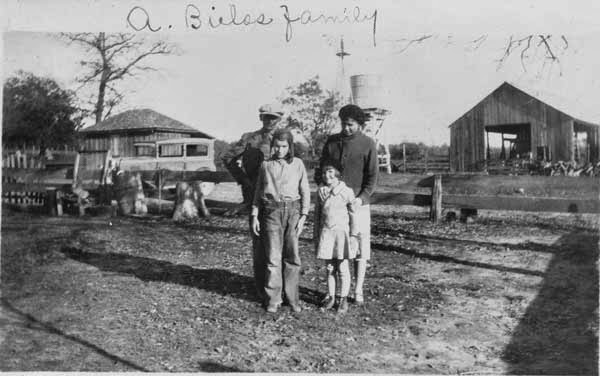
there. They weren't looking for a free ride. Weatherford resident Nila Bielss
Seale remembers those times as a girl. Remembers those people. Her parents, Mr.
and Mrs. Alvin Bielss were the Poor Farm's caretakers. Hired by the county from
the late 1920s through the early 1930s.
"It
was like a big home," she said. "All the people there were like aunts
and uncles. My mother and dad took care of them. They were doctor, nurse, and
psychologist".
The Poor
Farm consisted of two 160 acre tracts of land. The superintendent and his
family had a home out there. The house still stands, barely. There was a
barracks-like dormitory across the road from the family's house. Each Poor Farm
resident had a room off its center hallway. The dormitory had a large porch
across the front where the residents would often gather.
The Poor
Farm's large barn, smaller outbuildings, and a water trough inscribed by Nila's
daddy in 1923 also still remain. There's also a shack of a house off by itself,
being eaten alive by a tree, shared back then by a blind man and the farm's
Delco electrical system.
Joe C.
Moore was one of the early Parker County Commissioners. He reflected on the
court's thinking in starting the poor farm, in a Weatherford Weekly Herald
story September 21, 1911: "Editor: I desire to answer some of your
questions as to why the county poor farm was purchased, how used and what
revenue it produced. About 1881, soon after A. J. Hunter was elected county
judge, B.C. Tarkinton, Joe C. Moore, Frank Barnett and W. A. Massey were
commissioners. After an investigation, this court found that other counties had
farms that were a source of good revenue, a large savings to the taxpayers, and
a good thing in general."
"George
Abbott and wife were employed to superintend the farm with instructions to feed
and clothe well all inmates of the farm, and to give each of the inmates a task
according to their fittedness or ability."
The farm
was free and clear of debt after only three years. The commissioners additionally
used jail inmates to work at the farm. They received credit against their
sentences.
All
thirty-eight paupers under the county's financial support were then notified of
the day and time to assemble, to be taken to the Poor Farm. Steaming Nazi
locomotives pulling wooden-slatted cattle cars pop into my imagination as I
write this. Though that's probably not fair. I'm sure some thought, in Parker County
back then, these people must've brought it on themselves. They had it coming.
Apparently
only about half showed up, Mr. Moore tells us, "showing that the county
had been paying out money to those who had other means of support." No
such testing goes on today. Far as I know.
The Poor
Farm usually had between fourteen and twenty people living there at any one
time. Those that were able worked in the fields, gathered eggs, raised hogs and
cattle, milked or helped cook and clean back at the dormitory.
Aunt
Mary, one of the residents there, was a cook while the Bielss Family lived
there. The woman showed kindness to young Nila. "Aunt Mary made the best
tea cakes," she remembered. Once Nila's pet goat Billy, who followed Nila
everywhere, somehow got into Aunt Mary's room when the little girl was
visiting. Though Billy created quite a mess, Aunt Mary, known for her
organization and cleanliness, acted like nothing had happened.
Aunt Mary
grew tired in her later years and decided she was not going to help out around
the farm any longer. Her back was bothering her, she said. She could no longer
get around, she told some others. One afternoon, Nila's dad came up to the
dormitory's porch, where Aunt Mary was still feigning illness. He let a
harmless snake loose that promptly sought Aunt Mary out. Terrified of snakes,
she leapt from her chair and took off, promptly cured of her affliction.
"We
were almost totally self-sufficient," Nila said. "The people there
were very busy people. My mother and dad alternated each month in buying
groceries. Mother would get mad if the grocery bill was over twenty dollars for
the month (for about eighteen people). My dad butchered hogs after the first
cold spell and cured the meat. The cellar was full - the walls were lined with
fruits and vegetables my mother put up."
During
harvest season, when they would thresh the wheat, county commissioners would
pay people from Weatherford one dollar a day to work (during the Great
Depression). And people from town would come out, to help out - to get paid.
Nila's dad would salt meat and hang it from the rafters. When Poor Farm folks became ill, her mother or dad would sit up all night with them.
Nila had
a horse as a little girl. The commissioners apparently had confiscated the
animal from someone, to stop its abuse. "The horse wasn't quite
right," she remembered. "He would be perfectly sweet and
normal, then all of the sudden just go crazy for a little bit." Nila loved
that horse. One day she was riding him up by the big barn, through some old
tree stumps. The horse had one of his episodes. Threw her through the air and
onto the ground. Her dad was nearby. Thank goodness. Made sure she was okay.
She remembers this part. He told her to get right back up on that horse. So she
did.
The Poor
Farm owned a few other horses to pull the plows and wagons, even a couple of
Percherons at one point. Nila remembers her dad being partial to mules. These
teams would take corn to the gin in Granbury in a wagon, and would help harvest
the wheat. When it was ready.
Nila's
father often woke up at 3 a.m.
to begin his endless work around the farm. Near the end, most of the farm's
residents were advanced in age. Were not a lot of help.
"Daddy liked to whistle," Nila told me. "He was known for that. You could hear him, even at three in the morning, out there whistling." He was a deacon in the local church, where her mom taught Sunday School and played the piano. Before they were married, Mr. Bielss had to sell his beloved horse Penny. He needed the money. He wanted a proper wedding ring. He sacrificed.
Nila's
folks were good people, were hard workers. Nobody helped them out much except
for Moses, Mr. Taylor, and sometimes Aunt Mary. "Mr. Taylor, who was
blind, would want to help out more, but we were always afraid for him, when he
got around the big saw," Nila told me. He was a nice man, she said. Mr. Taylor.
Nila remembers
her family having a small record player. One day she and her brother Eldon were
playing "He'll Be Coming 'Round the Mountain" so loud that her mother
could hear it down the hill. They got into a storm of trouble. Before
electricity was common, the farm had a Delco unit powered by a windmill to run
a few things, like the single bulbs that hung from a few of the ceilings. The
Delco was located in same little house that Mr. Taylor lived in. The blind
gentleman.
Poor Farm
residents washed their clothes in big black number five wash pots. The man
named Moses kept pecans in a Maxwell Coffee can. He cut those pecans into
laser-perfect halves. Moses did. Moses was paralyzed on one side. Had a peg leg
that he made himself.
Nila told
me about Mrs. Baker, who'd been addled after being struck by lightning. It
stayed with her. Mrs. Baker. Whenever a storm approached, Nila's parents had to
comfort her fears.
Nila told
tales of a happy childhood at the farm. At the Poor Farm. Where her parents
took care of so many. Nila never lacked for anything, she wanted me to know.
Nila bottle fed her goats. Had a menagerie of livestock to keep her
entertained. She listened to Little Orphan Annie on the family's radio.
Around
1946 the dormitory building where the residents lived was moved to the 100
block of Throckmorton in Weatherford. It there served as a home for the aged.
The move was the end of the true operation of the Poor Farm. The building was
later relocated to Rusk Street ,
where it still stands.
I drive past it. Often. Though I've never ventured up to it. Wouldn't be polite.
After World War II, the federal and state governments increased social services for the poor and the elderly. For the nation. Not justParker County .
I drive past it. Often. Though I've never ventured up to it. Wouldn't be polite.
After World War II, the federal and state governments increased social services for the poor and the elderly. For the nation. Not just
The Poor
Farm pauper cemetery still sleeps off in the woods. The place was forgotten
until the early 1980s, rediscovered by a group of hunters. It appeared to have
about forty adult graves. And one child's grave. No one knows for sure.
The
earliest documented burial was 1904. The lonely site had no fence. At that time
the county commissioners were considering selling the farm. The Parker County
Historical Commission persuaded commissioners to let them restore the dignity
of the cemetery. This, they did.
Later in
1986 a historic marker was awarded by the state, now visible from Tin Top Road . A
right-of-way was established from Tin Top to the cemetery. The Parker County
Abandoned Cemetery Association continues to maintain the cemetery, with the
help of donations. They do this, to this day.
I need to
finish this story. There's much to do. To prepare for. I feel nauseous. Unsure.
I need a
snake to scare me off this porch.
One man
living at the Poor Farm was insistent that he not end up in the pauper
cemetery. When the time came, Mr. Bielss buried him off in the woods. Wayne
Thompson, who ran a dairy on the property in the 1950s remembers three lone
graves off together near a lone tree, about a half mile away. This man's
presumed to be one of the three. But I'm not sure.
J. G.
Godley's death was particularly tragic. Godley died of suicide November 11, 1929 . Nila
recalls that Godley was once a wealthy man (related to the family that started
the Godley community to our south). He was divorced, was 87 at the time of his
passing. He apparently squandered his fortune and died a pauper at the farm. He
was always very bitter and depressed, Nila told me. Many times he pleaded with
her dad to kill him.
One morning the Bielss Family was having breakfast. Before sunrise. The cows down the hill started bawling. Her dad got his lantern. Said he'd better go check on what was wrong. On what was the matter.
Mr.
Godley had cut his throat inside the farm's two hole privy. In the Poor Farm's
out house. He lay dead on the floor. The county death certificate lists no relatives
and no birthdate. The November 12, 19 29
Daily Herald obituary shows one daughter in Austin . I never found her.
Nila
remembers Mr. Godley being buried outside the paupers' cemetery fence by her
father. County records show his final resting place as Oakland Cemetery ,
in an unmarked grave. Stories about Mr. Godley conflict around this town, even
today. I believe that little girl, though bottom line, Mr. Godley is lost as
well.
The Poor
Farm Cemetery has one of the highest ratios of unmarked graves in Parker County .
Out forty known graves, only one had a marked headstone. There is a newer
granite marker listing the people who died at the farm, but were buried in
other locations. The Abandoned Cemetery Association did that.
Association
members Mary Kemp and Billie Bell spent long hours going through records trying
to learn the names of those interred at this cemetery. Mary helped me with this
story. Nila was its ringside witness.
I don't
know how this story comes out. The Poor Farm. Parker County .
The American nation writhing in doubt and uncertainty. Today's headlines could
be an echo to that earlier time.
We could
be in for the surprise of our lives.
The Poor
Farm woods south of Weatherford probably hold this nation's answer. The souls
in that graveyard. The whispers in those trees.Those times seem so foreign.
Listening to that little girl. To the slip-sliding past. Our future's out
there. A cradled secret, walking around in the faded front overalls pocket of
another time. But those folks aren't talking. Not today. Not to me.
SUGGESTED CAPTIONS
Depression-Era
residents sit on the front porch of the Poor Farm Dorm.
Nila’s
Family near the Poor Farm barnyard.
Subscribe to:
Posts (Atom)